
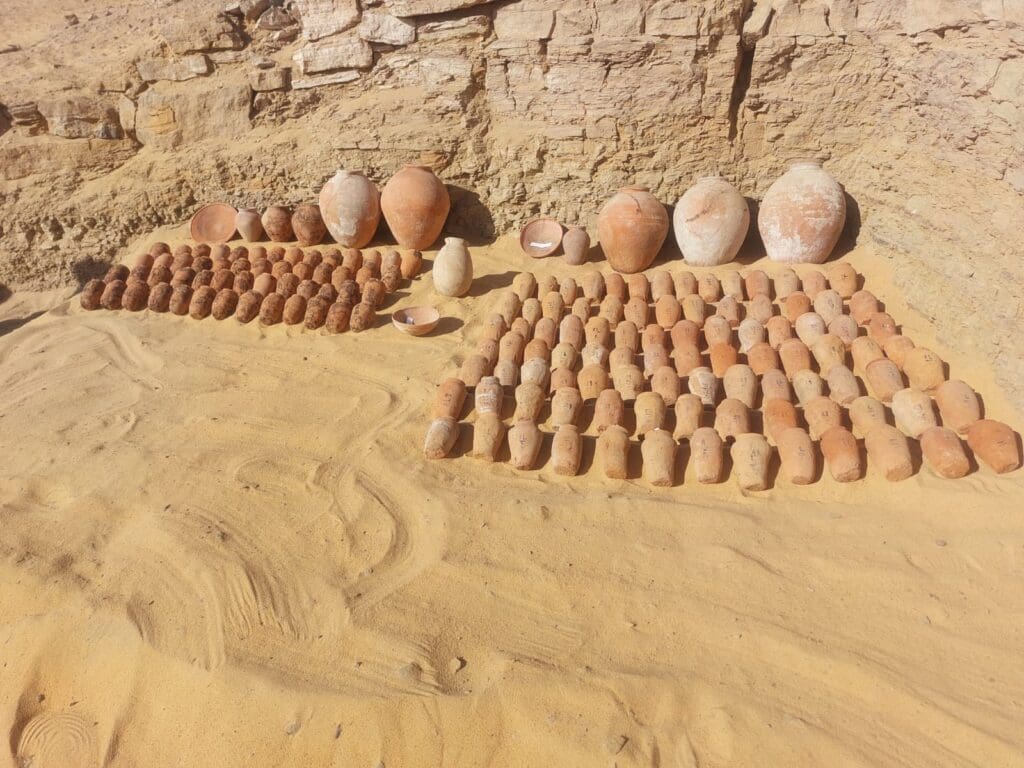
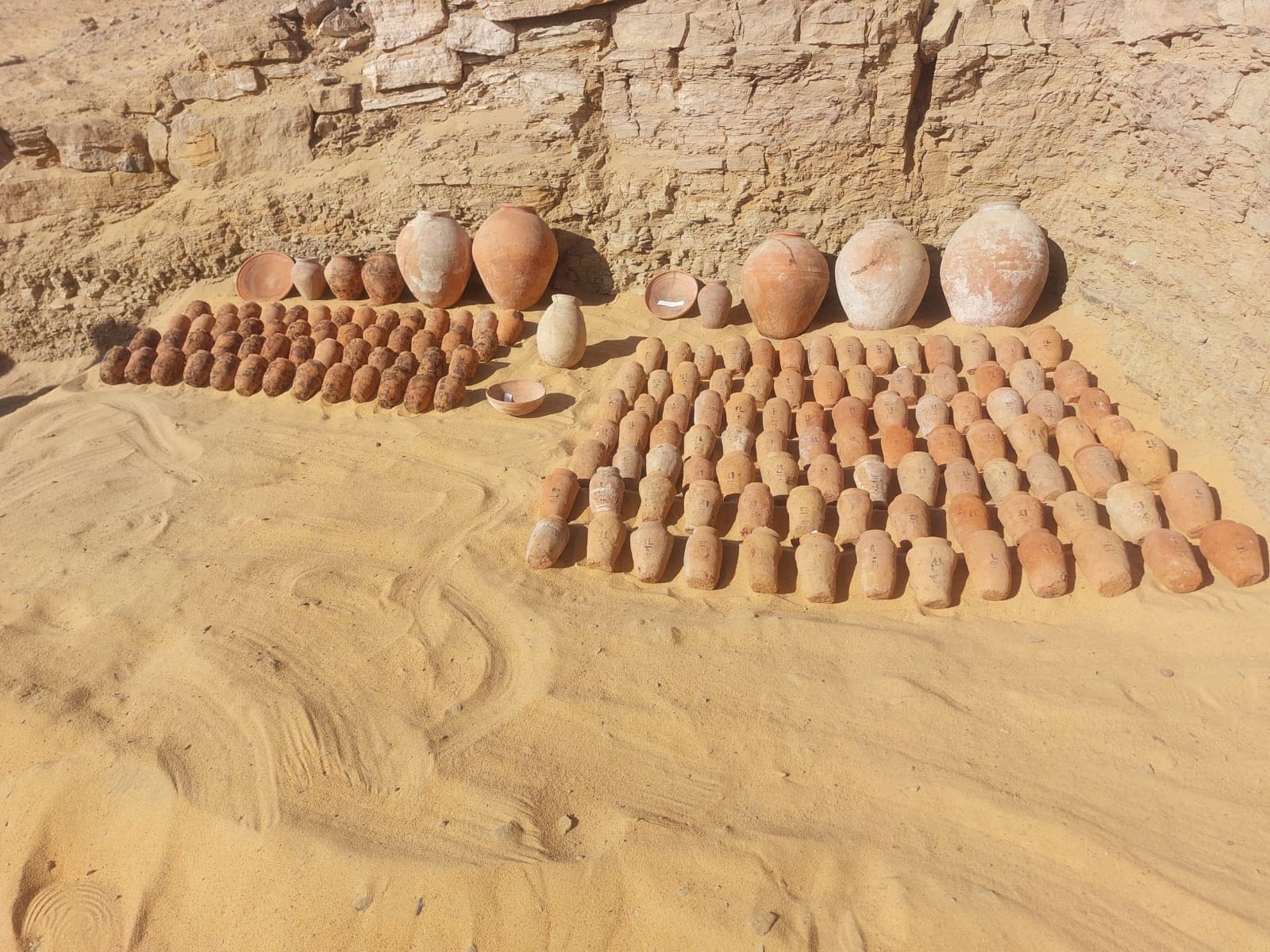
Just some of the approximately 160 pottery vessels found at Aswan in and around the Old Kingdom tombs. Courtesy Egyptian Ministry of Tourism and Antiquities.
A recent excavation by the Egyptian Ministry of Tourism and Antiquities has uncovered a cluster of rock-cut tombs in the Aswan region, near Egypt’s southern frontier with Nubia. Carved into the bedrock, the tombs feature vertical shafts, burial chambers, and associated architectural elements typical of elite funerary practices. Preliminary analysis dates the original construction of these tombs to the Old Kingdom (c. 2686–2181 BCE), a period known for its highly organized state administration and monumental mortuary culture. The tombs were reused in later periods, including the First Intermediate Period and the Middle Kingdom, suggesting that, like us, Egyptians could not get enough of their tombs.
The excavation revealed substantial material remains within and around the tombs. Most notable is the discovery of approximately 160 pottery vessels of varying shapes and sizes, many of which are well preserved. Some bear inscriptions in hieratic script, suggesting administrative or functional labeling, and preliminary interpretations indicate they were used to store liquids and food intended for the deceased in the afterlife. In addition to the pottery, archaeologists uncovered a range of funerary goods in the outer courtyard, including bronze mirrors, alabaster objects, and bead necklaces of different colors and designs. The mix of items shows exposure to different artistic styles, materials, and burial practices, suggesting that the site was connected to wider trade and cultural networks through time.
Mohamed Abdel-Badii, head of the Archaeological Sector of Egypt’s Supreme Council of Antiquities, suggests that the tombs had a long history of use beyond the Old Kingdom. They were reused in later periods, including the First Intermediate Period and the Middle Kingdom, and the site itself continued to be active into the Greco-Roman era. Studies are ongoing, but this pattern of reuse points to the enduring significance and changing customs of the site across time.
The region around Aswan, particularly the nearby island of Elephantine, became a key frontier zone where cultures intersected. In the first millennium BCE, this same area hosted a Jewish military community whose documents—known as the Elephantine Papyri—offer one of the clearest windows into life in the biblical world outside the lands of the southern Levant. These Aramaic texts record legal disputes, family matters, appeals to imperial authorities under Persian rule, and, shockingly, references to a temple of Yahweh maintained on the island, i.e., outside of Jerusalem.
Lauren K. McCormick is an assistant editor at Biblical Archaeology Review and a specialist in ancient Near Eastern religions, visual culture, and the Bible. She holds degrees in religion from Syracuse University, Duke University, New York University, and Rutgers University, and completed a postdoctoral fellowship on religion and the public conversation at Princeton University.
Become a BAS All-Access Member Now!
Read Biblical Archaeology Review online, explore 50 years of BAR, watch videos, attend talks, and more

Related reading in Bible History Daily
All-Access members, read more in the BAS Library
Not a BAS Library or All-Access Member yet? Join today.
The post Elite Old Kingdom Tombs Discovered in Aswan appeared first on Biblical Archaeology Society.
Comments
Post a Comment