
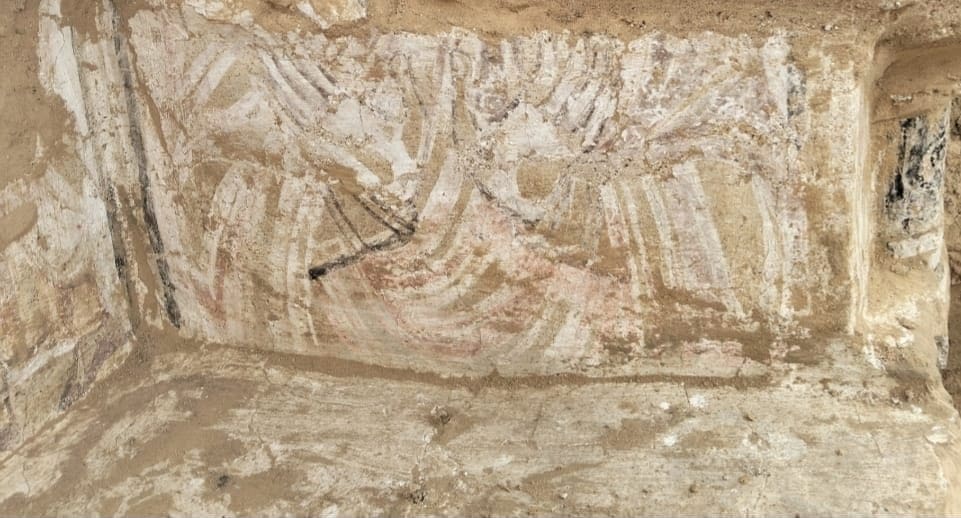
Mural with two deer facing each other, a circular element between, and vegetal motifs around. Found in a fifth-century CE monastic complex in Egypt’s Kalaya region. Courtesy the Egyptian Ministry of Tourism and Antiquities.
“As the deer pants for streams of water, so my soul pants for you, O God.”
–Psalm 42:1
Recent excavations in Egypt’s Kalaya region in the Beheira governorate have uncovered a fifth-century CE building that offers a detailed glimpse into early Coptic monastic life. The site lies in a transitional landscape where the fertile Nile Delta meets the desert, where monks could withdraw from urban life while remaining close enough to food and water to sustain a community. A deer mural was found inside the monastic complex, providing a vivid expression of the monks’ deep yearning for the divine.
The site carries considerable historical weight: According to Egypt’s Supreme Council of Antiquities, Kalaya was the second-largest monastic complex in the history of Egyptian Christianity. The organization reported on social media that archaeologists identified 13 rooms serving individual and communal living, hospitality, and instruction. A large northern hall with stone beams carved with botanical motifs appears to have been a reception space, and a limestone cross on the eastern wall likely marked a prayer area. Kitchens, storerooms, and evidence of later architectural additions round out a picture of a stable, evolving community.
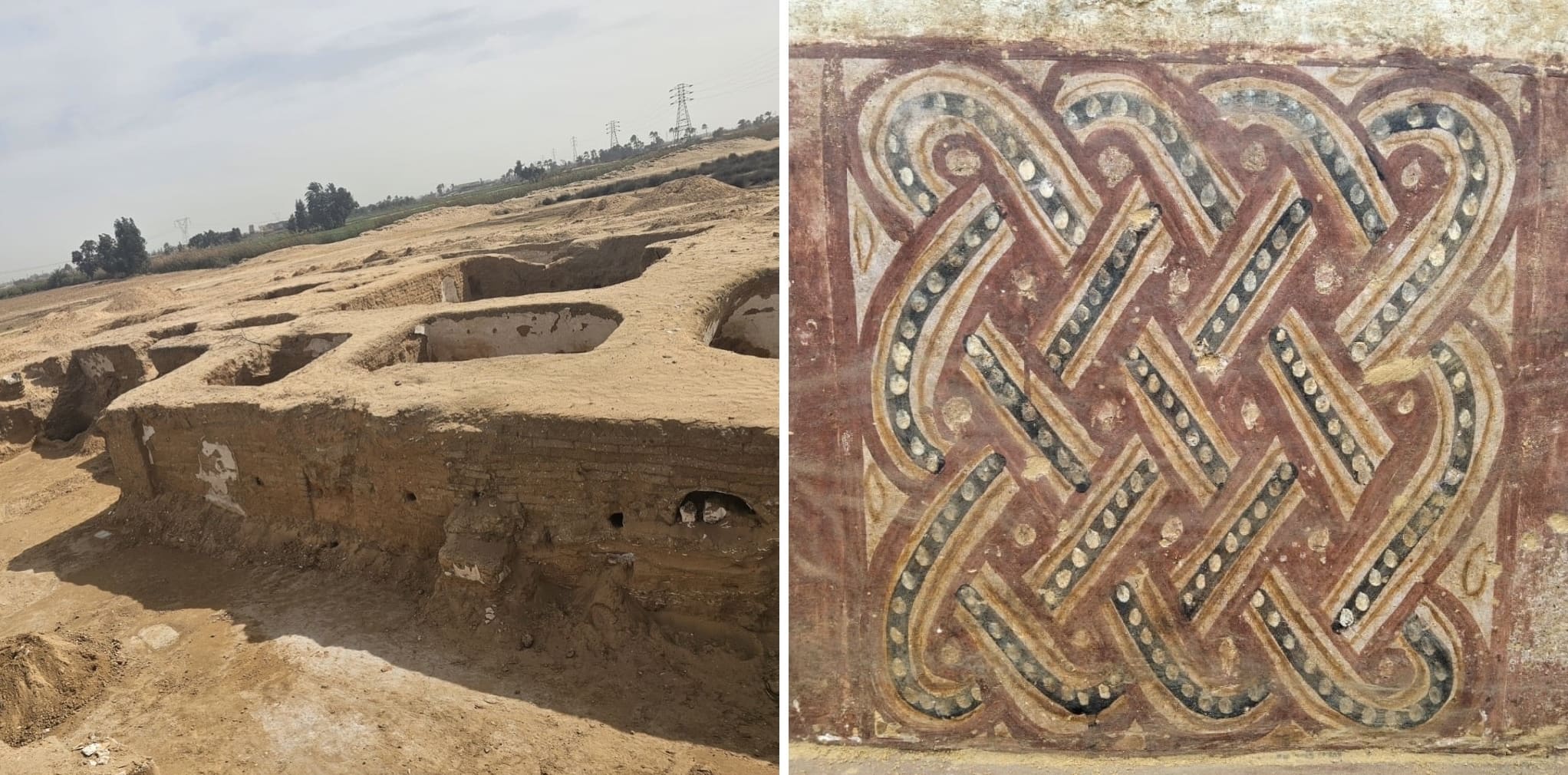
Monastic complex uncovered in Egypt’s Kalaya region at left. Wall mural with red, black, and white braided pattern at right. Courtesy the Egyptian Ministry of Tourism and Antiquities.
Beyond the architecture, the excavation revealed a rich array of artistic and material remains. A rectangular limestone slab discovered at the entrance of one of the chambers bears a Coptic inscription that seems to mark the grave of a man named Abba Kir bin Shenouda. Wall paintings depict monastic figures alongside decorative elements such as braided patterns in red, white, and black (pictured above), geometric forms including an eight-petaled flower, and a variety of plant motifs. Pottery fragments—some inscribed with Coptic letters—were found, along with column bases, capitals, and one marble column that is almost 7 feet tall. Organic remains, including animal bones and oyster shells, offer insight into aspects of daily life such as diet and food preparation.

FREE ebook: Masada: The Dead Sea’s Desert Fortress. Discover what archaeology reveals about the Jewish rebels’ identity, fortifications and arms before their ultimate sacrifice.
Among the finds, one mural depicts two deer surrounded by vegetal motifs within a circular decorative frame. Deer are a surprising choice. Egypt’s native large mammals lean more toward adapted desert species like ibex, foxes, and gazelles. However, for communities shaped by the Bible, the deer likely evoked Psalm 42:1 (above). Deer are not efficient panters like dogs: They primarily cool down through their skin and by seeking shade or water. Panting signals physical need and desperation—it signals a deer in trouble.
In this context, the deer in the monastery’s mural symbolizes spiritual longing, thirst, and dependence on God. The monastery’s presence in the transitional desert–delta landscape makes the choice of deer especially evocative. For a deer, an animal of streams and shade, to be in this landscape means it has found sustenance. The monks seem to have found in the deer a powerful emblem of their own spiritual condition.
Lauren K. McCormick is an assistant editor at Biblical Archaeology Review and a specialist in ancient Near Eastern religions, visual culture, and the Bible. She holds degrees in religion from Syracuse University, Duke University, New York University, and Rutgers University, and completed a postdoctoral fellowship on religion and the public conversation at Princeton University.
Become a BAS All-Access Member Now!
Read Biblical Archaeology Review online, explore 50 years of BAR, watch videos, attend talks, and more

Related reading in Bible History Daily
All-Access members, read more in the BAS Library
Not a BAS Library or All-Access Member yet? Join today.
The post Feeling the Longing of Early Christian Monks appeared first on Biblical Archaeology Society.
Comments
Post a Comment