
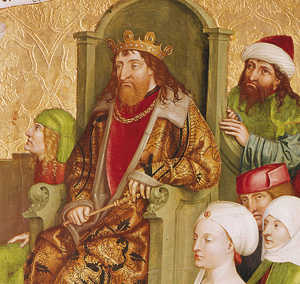
Although he ruled as tetrarch over Galilee in Jesus’ time, we hear relatively little about Herod Antipas in the Bible and other ancient sources of the period. Was Herod Antipas (depicted in a painting above) an aggressive tyrant like his father, Herod the Great, or was he simply a perplexed ruler who didn’t know what to do about Jesus and his followers? Photo: SEF/Art Resource, NY.
Herod Antipas is known mostly as the Herod for whom Salome danced and who ordered John the Baptist to be beheaded.
Herod Antipas ruled Galilee in Jesus’ time. He succeeded his father, Herod the Great, and served as tetrarch (appointed by the emperor Augustus to rule over one quarter of his father’s kingdom) from 4 B.C. until 39 A.D., almost exactly the lifetime of Jesus. Yet there is relatively little about Antipas in the Bible.
According to Biblical scholar Morten Hørning Jensen in “Antipas—The Herod Jesus Knew” in the September/October 2012 issue of BAR, in the three synoptic Gospels (Matthew, Mark and Luke), Herod Antipas’s attitude toward Jesus is somewhat vague and indecisive:
In Matthew and Mark, Herod Antipas is ambivalent with regard to Jesus. Both gospels quote Herod Antipas as saying, after he has had John the Baptist executed, that Jesus is actually John resurrected (Matthew 14:1–2; Mark 6:14–16). Both gospels state that Antipas was actually saddened by Salome’s request to have John beheaded (Matthew 14:9; Mark 6:26), and they seem to blame Salome and her mother, Herodias, for John’s execution. Bound by his own oath, Antipas is nevertheless forced to fulfill his promise to Salome.
At the same time, however, we get the feeling in Matthew and Mark that Antipas is a shadow of death over Jesus. When Jesus hears that John has been killed, “he withdrew from there in a boat to a lonely place,” apparently fearful of Antipas (Matthew 14:13). In Mark 3:6, the Herodians counsel about how to kill Jesus, just as Jesus in Mark 8:15 warns against “the leaven of Herod.”
Luke’s account differs from Matthew’s and Mark’s by concentrating mostly on the trial of Jesus, for which Luke skillfully prepares his reader by references to Antipas along the way that build up an intense question in the reader’s mind: Is Antipas interested in Jesus or is he trying to kill him? (See Luke 3:19–20, 9:7–10, 13:31–33.)

FREE ebook: The Galilee Jesus Knew
So what can archaeology tell us about this not-so-great Herod?
Unlike his father, Antipas was not much of a builder. Although he founded cities and may have built theaters at Sepphoris and Tiberias, the building projects were relatively small compared to the later Roman-period structures that can be seen there today.
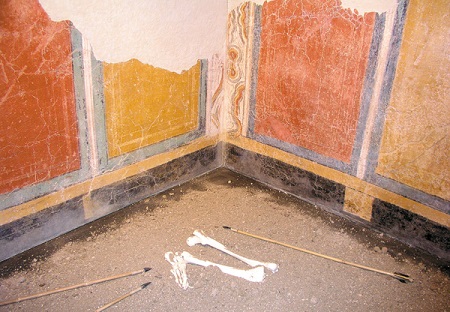
Although poverty was a fact of life for some in this period, Galilee in general was thriving economically. This can be seen especially at Yodfat, where elite houses featured high-quality frescoes. Photo: Shai Levi, Hecht Museum, University of Haifa.
Even the coins that Herod Antipas minted were relatively few and simple—especially compared with those of his co-tetrarch brother Herod Philip. Unlike his brother, he took care not to offend the religious sensibilities of his Jewish subjects with graven images and pagan temples.
Become a BAS All-Access Member Now!
Read Biblical Archaeology Review online, explore 50 years of BAR, watch videos, attend talks, and more

And even while poverty was a fact of life for some in first-century Galilee, archaeological surveys and excavations show that the region in general was thriving economically under Antipas, even in the rural areas. As Jensen explains, this does not match earlier proposals of a devastating urban elite’s exploitation of a uniformly poor peasant population. Despite his enigmatic and sometimes inimical depiction in the New Testament, Antipas seems to have been a fairly passive but successful ruler of Galilee.
For more about what we know of Herod Antipas in the Bible and archaeological finds indicating how he ruled Galilee in Jesus’ time, see “Antipas—The Herod Jesus Knew” by Morten Hørning Jensen in the September/October 2012 issue of Biblical Archaeology Review.
All-Access subscribers: Read the full article “Antipas—The Herod Jesus Knew” by Morten Hørning Jensen as it appears in the September/October 2012 issue of Biblical Archaeology Review.
Not a BAS Library or All-Access Member yet? Join today.
Related reading in Bible History Daily
All-Access members, read more in the BAS Library
Machaerus: Where Salome Danced and John the Baptist Was Beheaded
Not a BAS Library or All-Access Member yet? Join today.
The post Herod Antipas in the Bible and Beyond appeared first on Biblical Archaeology Society.
Comments
Post a Comment