
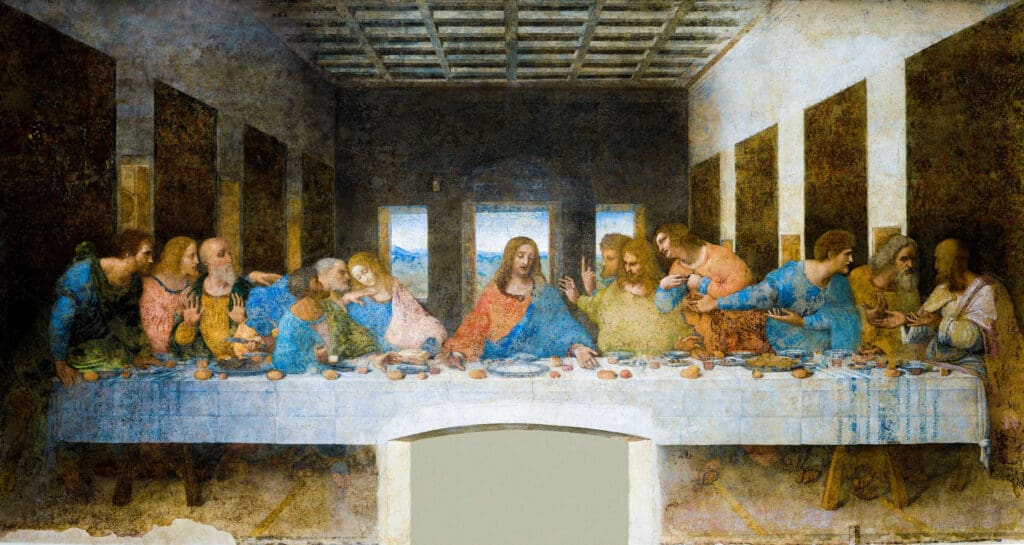
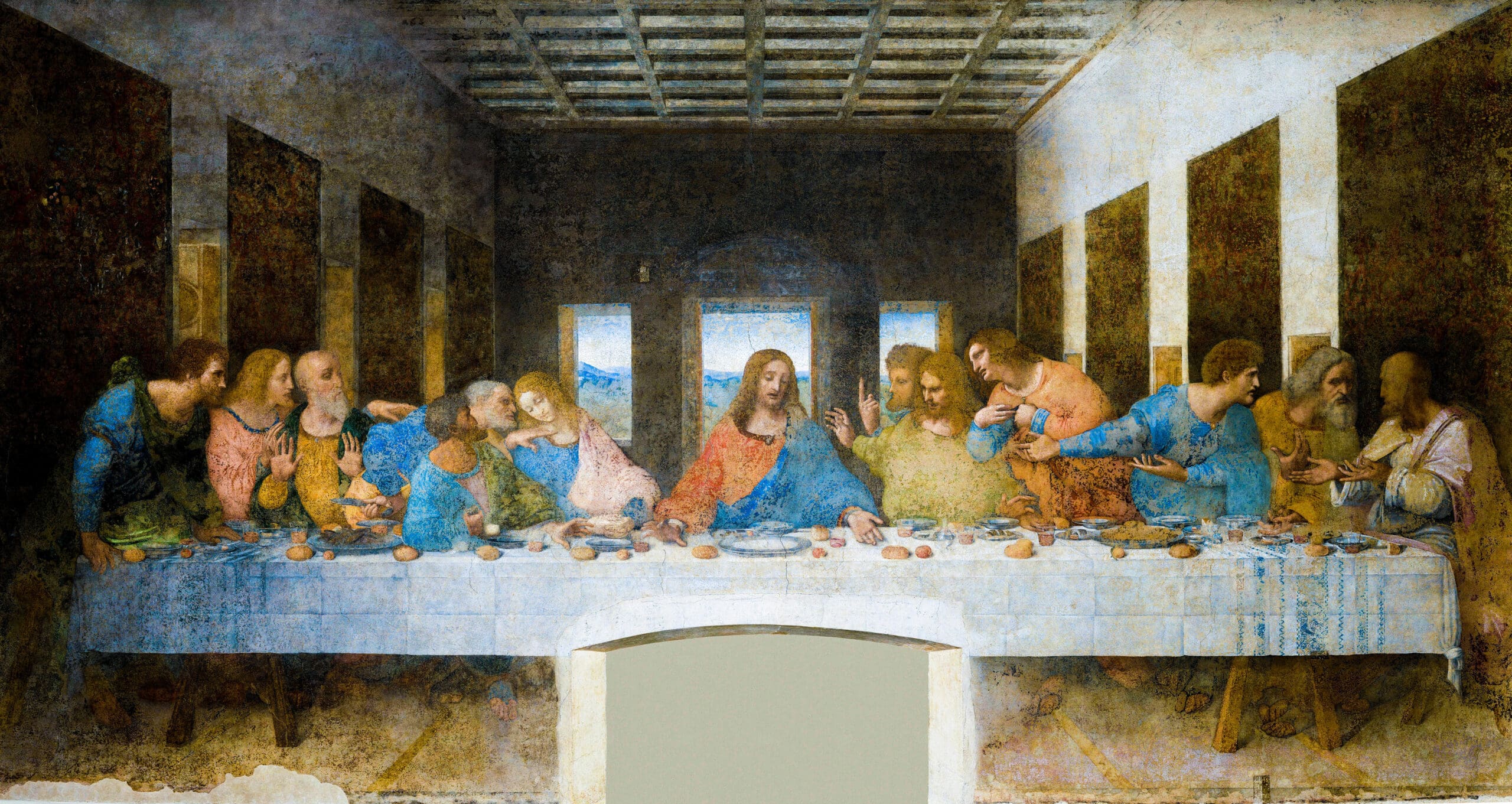
Leonardo da Vinci, The Last Supper, 1495–1497. Incamerastock / Alamy
When Jesus and his disciples gathered for the Last Supper, how was the meal laid out? Did the group emulate the Roman dining practice of the triclinium, reclining at low tables arranged in a U shape and eating from individual place settings? Or did they sit around an arrangement of communal dishes from which all individuals partook? In the Spring 2026 issue of Biblical Archaeology Review, in his feature article titled “What Did the Last Supper Really Look Like?,” Matthew J. Grey considers these questions, shedding valuable light on the workings of this famous feast.
Grey begins by highlighting the ways in which the Last Supper has been depicted over the centuries. Early representations, from late antiquity through the Renaissance, typically made little effort to imitate any sort of historical reality, focusing instead on the theological and symbolic significance of the biblical story and the physical objects involved. Jesus and the disciples tended to be shown in a lavish contemporary dining space, on cushioned seats around or along one side of a central table set with elegant serving dishes. While such depictions bore virtually no resemblance to an authentic first-century space, they enabled artists like Leonardo da Vinci to explore thematic elements, symbols, and individual persons with great artistic freedom.
By the end of the 18th century, however, Western scholars and artists began to attempt a more historically-rooted setting for the Last Supper. Informed by their reading of Greco-Roman literature, as well as the discovery of Roman dining rooms at Pompeii and Herculaneum, they imagined a reconstruction that placed the feast in a Roman-style triclinium—an elaborate dining room, often adorned with frescoes and floor mosaics, with low tables arranged in a U shape so that servers could move freely in the middle while guests reclined along the outer sides of the tables to eat. In the context of Roman dining, such spaces likely would have been filled with the sounds of conversation and music as the guests enjoyed themselves.
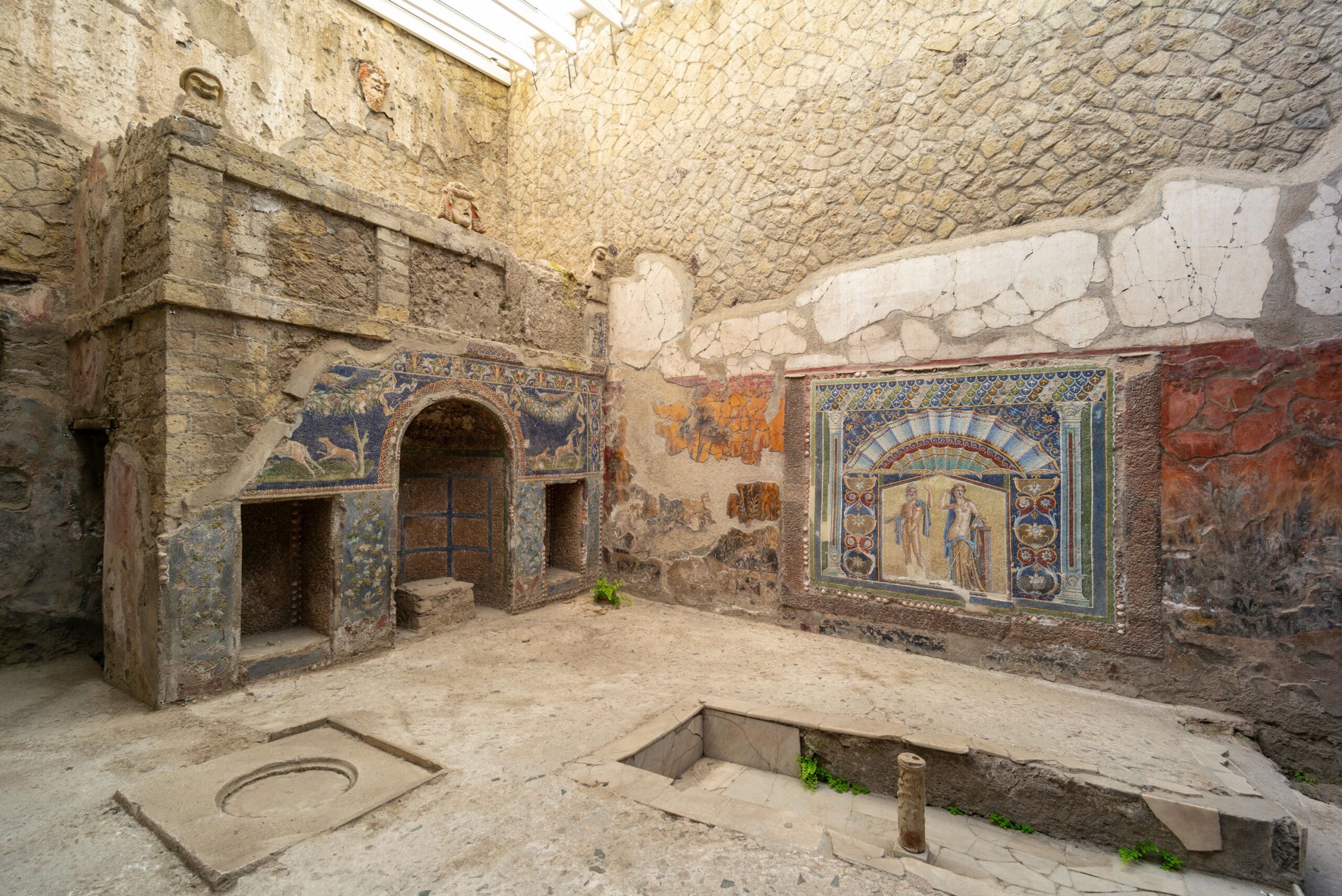
Triclinium-style dining room discovered at Herculaneum. Adam Eastland / Alamy
Once it had been proposed, Grey observes, the idea that the Last Supper took place in a triclinium quickly came to dominate the popular imagination. Both Christian art and biblical commentaries took up this idea; indeed, the standard features of the triclinium—including the implied social hierarchy, with the most honored guest reclining on the highest couch and others arranged at lower positions around the tables—came to serve as a means of interpreting the Last Supper accounts. Even today, many modern English versions of the New Testament revise the traditional translation, which describes Jesus and the disciples as “sitting and eating,” to the more descriptive expression “reclining at table and eating” (compare, e.g., the KJV and ESV of Mark 14:18).

FREE ebook, Who Was Jesus? Exploring the History of Jesus’ Life. Examine fundamental questions about Jesus of Nazareth.
But is this an accurate reflection of such a gathering in first-century Judea? Archaeological discoveries in recent decades have revealed that the Roman-style triclinium did indeed occur in the region during this time. But it seems to have been adopted primarily (if not exclusively) by Judean elites with the means and cultural inclination to imitate Roman dining practices. Under both the Hasmonean dynasty of the last two centuries BCE and the Herodian client-kings before and after the turn of the Era, royal palaces at places like Jericho, Masada, Caesarea, and Herodium incorporated well-appointed triclinia to serve as their most prestigious dining spaces.

This dining room in the northern palace at Masada, built by Herod the Great, likely would have been arranged as a triclinium. Vivita / Alamy
Comparable spaces existed also in elite residences in Jerusalem, and it certainly is plausible that aristocratic visitors or pilgrims to Jerusalem might have been entertained as guests in such spaces. But this almost certainly was not the reality experienced by most families, who would not have had the economic means, the space, or the cultural capital to imitate elite Roman dining practices. Instead, they would have consumed meals in a manner called “common dining,” a style that is well represented in the archaeological profile of non-elite homes in Judea, the Galilee, and the Golan. Limited space in these residences meant that dining often took place in a multi-purpose common area of the home, without any trace of luxury furnishings. The pottery, too, is markedly different, comprising common vessels for cooking and serving that would have been shared by all in attendance.
In fact, Grey posits that there is even evidence that this mode of consumption was maintained not only for economic reasons, but also as “an ideological statement against the perceived compromises of Romanization.” Contemporary literature appears to reveal that some sectarian groups, such as the group who lived at Qumran, deliberately rejected triclinium dining in favor of some type of common dining.
Become a BAS All-Access Member Now!
Read Biblical Archaeology Review online, explore 50 years of BAR, watch videos, attend talks, and more

In sum, then, the available evidence suggests that most of Judean and Galilean society dined in the common manner, rather than in the fashion of the Roman-style triclinium. For this reason, Grey suggests that the historical background of the Last Supper most likely resembled the common dining practice of most of the populace, rather than the triclinium style of elite Roman dining. Gathering evidence from the Gospels, Grey highlights the language used to describe the group’s dining posture in Matthew and Mark, where the general verb for “sitting” or “taking their places” (anakeimai) does not necessarily refer to “reclining.”
Given these factors, Matthew J. Grey concludes that “the most compelling way to imagine Jesus’s Last Supper is not by placing him and the disciples in a Roman-style triclinium, but by placing them in a much more modest domestic setting reflective of the common dining practices of the Judean masses.” For his full articulation of the evidence, read his article “What Did the Last Supper Really Look Like?” in the Spring 2026 issue of Biblical Archaeology Review.
Subscribers: Read the full article, “What Did the Last Supper Really Look Like?” by Matthew J. Grey, in the Spring 2026 issue of Biblical Archaeology Review.
Not a BAS Library or All-Access Member yet? Join today.
Related reading in Bible History Daily
All-Access members, read more in the BAS Library
Biblical Views: From Supper to Sacrament: How the Last Supper Evolved
Not a BAS Library or All-Access Member yet? Join today.
The post Laying Out the Last Supper appeared first on Biblical Archaeology Society.
Comments
Post a Comment