
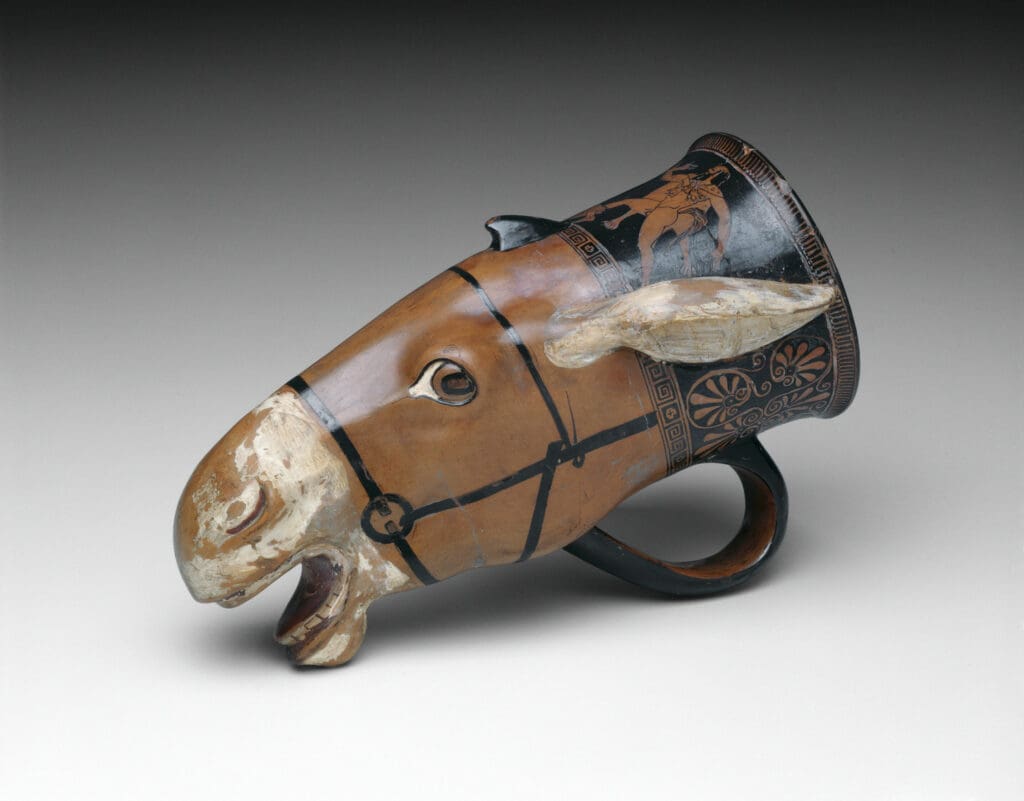
Terracotta rhyton (drinking vessel) in the shape of a donkey head, Greek, c. 480–470 BCE. CC0 Public Domain, via The Art Institute of Chicago.
A recent journal article by Classics scholar Anna Athanasopoulou argues that the second to third-century CE narrative Onos challenges how scholars understand sexuality in ancient novels. Greek novels often invite readers into a game of gradual revelation, where sexual desire is teased out slowly. Literary theorist Roland Barthes described this narrative structure as a kind of “striptease.” At the same time, many writers in the Greco-Roman world interpreted the body symbolically, treating visible realities as signs of deeper truths. In the New Testament, Paul participates in this kind of thinking when he describes the body as a “temple of the Holy Spirit” and treats sexual behavior as morally and spiritually significant. Onos, on the other hand, fixates on what is immediate, and even pokes fun at the impulse to constantly dig deeper. In other words, the novel offers the timeless voice of the cynic.
Onos (“donkey”) is part of a complicated textual tradition: It shares motifs and characters with other prose narratives like Apuleius’s The Golden Ass, suggesting it circulated as part of a larger network of stories. Onos follows Lucius, a curious traveler fascinated by magic and religious practice. His desire to witness hidden rituals leads him to experiment with bodily transformation. The experiment goes wrong and instead of becoming a bird he becomes a donkey (giving the novel its name). Humiliating and often comedic scenes ensue as Lucius searches for roses that will restore his human form.
Among his misadventures is an encounter with a woman who willingly sleeps with him while he is a donkey. The scene is deliberately excessive and uncomfortable, reflecting ancient literary playfulness and satire rather than an endorsement of bestiality. It is a narrative spectacle underscoring how far astray Lucius’s curiosity has led him. The narrator even specifies that a large lamp illuminates the room, ensuring that every detail of the encounter will be seen. Neither Lucius nor the reader may take refuge in darkness and the narrator unflinchingly describes the motions and mechanics of the sexual act. Nothing about the episode encourages the reader to search for symbolic meaning behind the bodies on display.
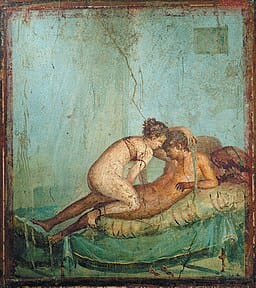
Intimate scene from the House of the Centurion, Pompeii (c. 70 CE). Public Domain CC0, via Wikimedia Commons.
In her article, Athanasopoulou suggests that this emphasis on surfaces mirrors the visual culture of the Roman Empire. Erotic scenes circulated widely on lamps, wall paintings, and luxury objects. These images displayed sexuality openly. In a similar way, Onos continually returns the reader’s attention to physical action rather than moral allegory.
The ending of the novel makes this approach unmistakable. When Lucius finally regains his human form, the story is poised for resolution and, finally, an explanation of the significance of Lucius’s journey. Instead, the woman who previously enjoyed sex with Lucius rejects his advances since he no longer possesses the animal’s “mighty symbol.” Refusing to elevate sex into revelation, the story ends with a joke about Lucius’s disappointing human anatomy. His attempt to uncover hidden knowledge turned him into a donkey and the novel’s last words are Lucius’ reflection that he has now been freed from “the curiosity of an ass.”
In antiquity as today, there were religious believers and skeptics. Not to be dismissed as mere crude humor, Onos develops Lucius as a character who sincerely wants to know what lies beneath the surface. He wants to learn how magic works, what happens to the soul in transformation, and what secrets religious rituals reveal. The novel is not ignorant of the search for hidden truths, it just questions whether that search always leads somewhere profound.

FREE ebook: Masada: The Dead Sea’s Desert Fortress. Discover what archaeology reveals about the Jewish rebels’ identity, fortifications and arms before their ultimate sacrifice.
Paul and the author of the Onos operated within intellectual environments where people looked for hidden meanings. Paul evangelized cities of the eastern Roman Empire—places like Corinth, Thessalonica, and Ephesus—where mystery cults of Isis, Dionysus, and Mithras were common. These religions often involved initiation rituals, secret knowledge, symbolic meals, and ideas of transformation or rebirth, frequently expressed through ritualized bodily acts.
Seen this way, Onos does not present a pagan failure that Christianity corrects. Paul was in good company treating the body as morally and spiritually significant in the pursuit of religious knowledge. Onos demonstrates a parallel current of Greco-Roman skepticism, one that lampoons the familiar impulse toward depth. Both participate in a broader ancient conversation about whether the physical world—experienced through sex or anything else—points beyond itself. Paul answers that question with a resounding yes. Onos answers by asking, with a smile, whether the search for hidden meaning is at least sometimes asinine.
Lauren K. McCormick is an assistant editor at Biblical Archaeology Review and a specialist in ancient Near Eastern religions, visual culture, and the Bible. She holds degrees in religion from Syracuse University, Duke University, New York University, and Rutgers University, and completed a postdoctoral fellowship on religion and the public conversation at Princeton University.
Become a BAS All-Access Member Now!
Read Biblical Archaeology Review online, explore 50 years of BAR, watch videos, attend talks, and more

Related reading in Bible History Daily
All-Access members, read more in the BAS Library
Not a BAS Library or All-Access Member yet? Join today.
The post Sex and the Search for Religious Truth appeared first on Biblical Archaeology Society.
Comments
Post a Comment