
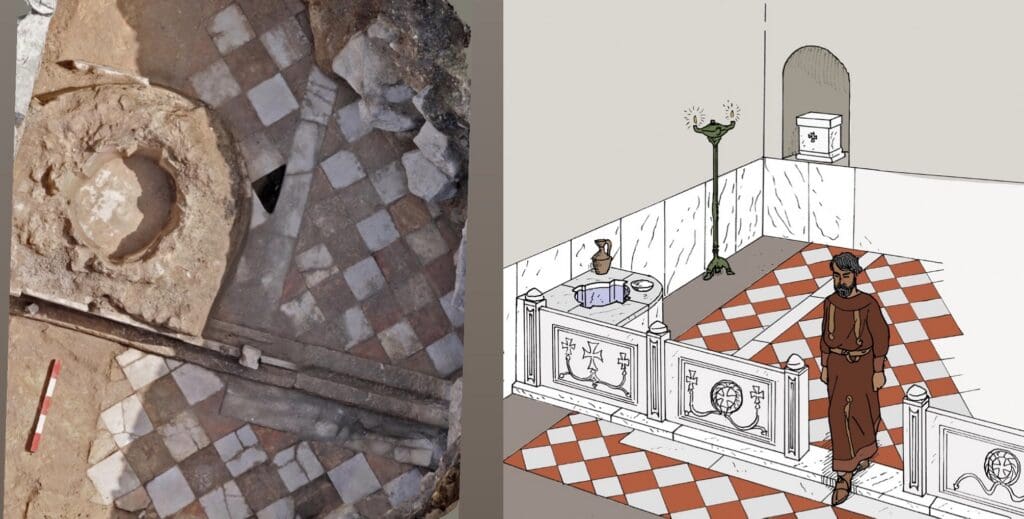

The southern photisterion found in the cathedral at Hippos; archaeological remains at left and artistic reconstruction at right. Courtesy Michael Eisenberg.
Standing on the western shore of the Sea of Galilee, you can look east and see a flat-topped mountain rising dramatically above the water. In the time of Jesus, the city of Hippos crowned that hill, gleaming and visible for miles in every direction. It may even be the city Jesus had in mind in the Sermon on the Mount when he told his followers: “You are the light of the world. A town built on a hill cannot be hidden” (Matthew 5:14). Centuries later, that same hill became one of the most remarkable centers of Christian worship in the ancient world. Due to a catastrophic earthquake in 749 CE, some of its secrets have survived into the present day. A recent archaeological study brings several of them to light, with a remarkable cluster of astonishing and, in some cases, previously unattested finds.
Archaeologists excavating the Byzantine-period cathedral at Hippos uncovered a cathedral with not one but two baptismal halls, known in Greek as photisteria or “places of illumination.” In a departure from the widespread practice of adding baptismal fonts into existing spaces like side chapels and preparation areas, the northern photisterion—the larger of the two baptismal halls—is the biggest structure purpose-built for baptism found anywhere in Byzantine Palestine. This space had a font fed by a lead pipe carrying flowing water, mosaic floors with inscriptions invoking light and life, and dedications to the beloved Saints Cosmas and Damianus.
The southern hall, by contrast, had a smaller font using still water that was tucked into the corner of what had originally been a martyrion—a chapel for saint veneration, in this case involving relics. At some point after 590 CE, someone decided to add a baptismal font here, despite the larger one already in operation in the northern hall. The southern space was defined architecturally by two marble chancel screens—low partitions separating the more sacred inner space from the area beyond—each about four feet long and decorated with ivy branches and crosses. Within the screened space, buried under earthquake rubble for over a thousand years, lay an extraordinary collection of sixth-century CE liturgical objects:
1) A large brass candelabrum still standing near the baptismal font.
2) A rectangular marble block with three identical hemispherical cavities carved on top (see below). Nothing like it has ever been found. The archaeologists believe it held oils—possibly three different kinds—used in the anointing rituals that accompanied baptism. This small stone block may be the first physical evidence ever recovered of a practice described in early Christian writings: the use of different oils at different moments in the baptismal rite.
3) A small round marble pedestal decorated with four encircling ridges. It was probably designed to support a small decorative column or similar object, but nothing was found sitting on top. No other artifact like it has ever been found.
4) A heavy marble reliquary—a container for the physical remains of a saint—weighing around 93 pounds. This is the largest reliquary yet found in the Holy Land, and it was found fallen on its side on top of a decorative stone tile floor.
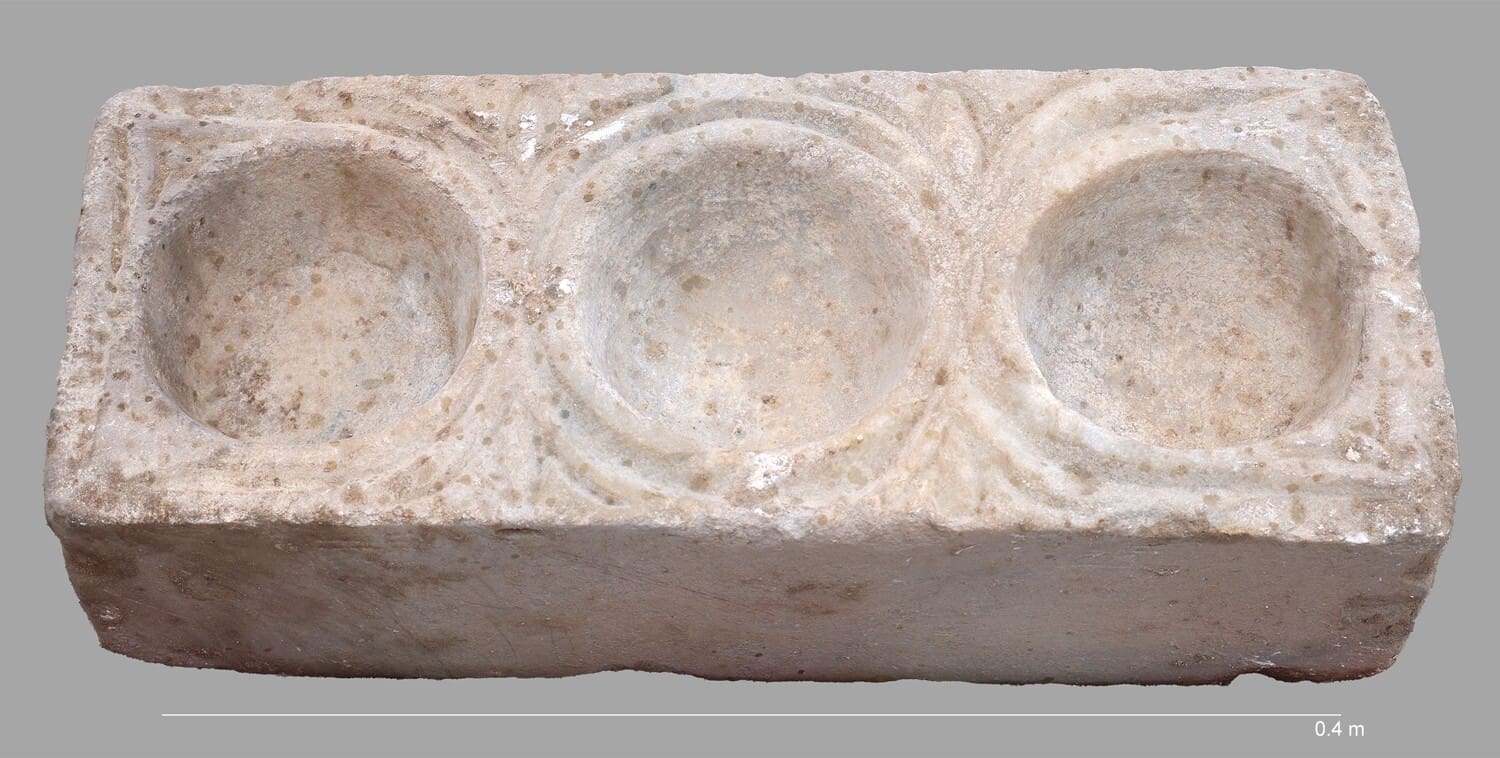
The three-cavity marble block found in the southern photisterion. Courtesy Michael Eisenberg.
The candelabrum, the three-cavity marble block, and the decorative pedestal were found clustered near the southern hall’s baptismal font, whereas the reliquary was found somewhat apart from them, toward the middle of the room. This separation may reflect distinct functions of the space: the martyrion in one area and the baptismal font in the other.
There are six other churches within the city walls of Hippos, and no photisterion has been found in any of them. Why did this cathedral have two? The archaeologists admit that they do not fully know. Perhaps two fonts allowed two baptisms to take place simultaneously with separate ceremonies and crowds; perhaps the smaller font served infants while the larger served adults; perhaps the presence of the martyr’s relics contributed some meaning to the baptismal rites; or perhaps the two fonts reflect two different ritual traditions: the northern font involving flowing “living water” and the southern involving still water, each carrying different theological weight. Perhaps all of these things were true at once.

FREE ebook, Who Was Jesus? Exploring the History of Jesus’ Life. Examine fundamental questions about Jesus of Nazareth.
Although there is no evidence of any miracle or pilgrimage destination at Hippos, this stretch of the Galilee shoreline was saturated with sacred memory for early Christians. Just three miles north of Hippos lay Kursi, the site traditionally associated with the Miracle of the Swine. According to this story, recounted in texts like Mark 5:1–20, Jesus cast out a demon who called itself “Legion,” sending it from its human host into a herd of pigs that then rushed into the sea and drowned. Famous for this Gospel miracle, the town of Kursi boasted a large basilica and monastery. Together, the two sites—Kursi and Hippos—paint a picture of a remarkably Christianized stretch of shoreline in the Byzantine period.
In Hippos, on the shore of the Sea of Galilee, in the shadow of the hill where Jesus may have preached, a small city developed a rich and distinctive liturgical life, wrestling, it seems, with questions of how to baptize, with what water, with what oils, and in whose presence.
Lauren K. McCormick is an assistant editor at Biblical Archaeology Review and a specialist in ancient Near Eastern religions, visual culture, and the Bible. She holds degrees in religion from Syracuse University, Duke University, New York University, and Rutgers University, and completed a postdoctoral fellowship on religion and the public conversation at Princeton University.
Become a BAS All-Access Member Now!
Read Biblical Archaeology Review online, explore 50 years of BAR, watch videos, attend talks, and more

Related reading in Bible History Daily
All-Access members, read more in the BAS Library
Not a BAS Library or All-Access Member yet? Join today.
The post Unprecedented Discoveries of Christian Baptism Found on the Shore of Galilee appeared first on Biblical Archaeology Society.
Comments
Post a Comment