

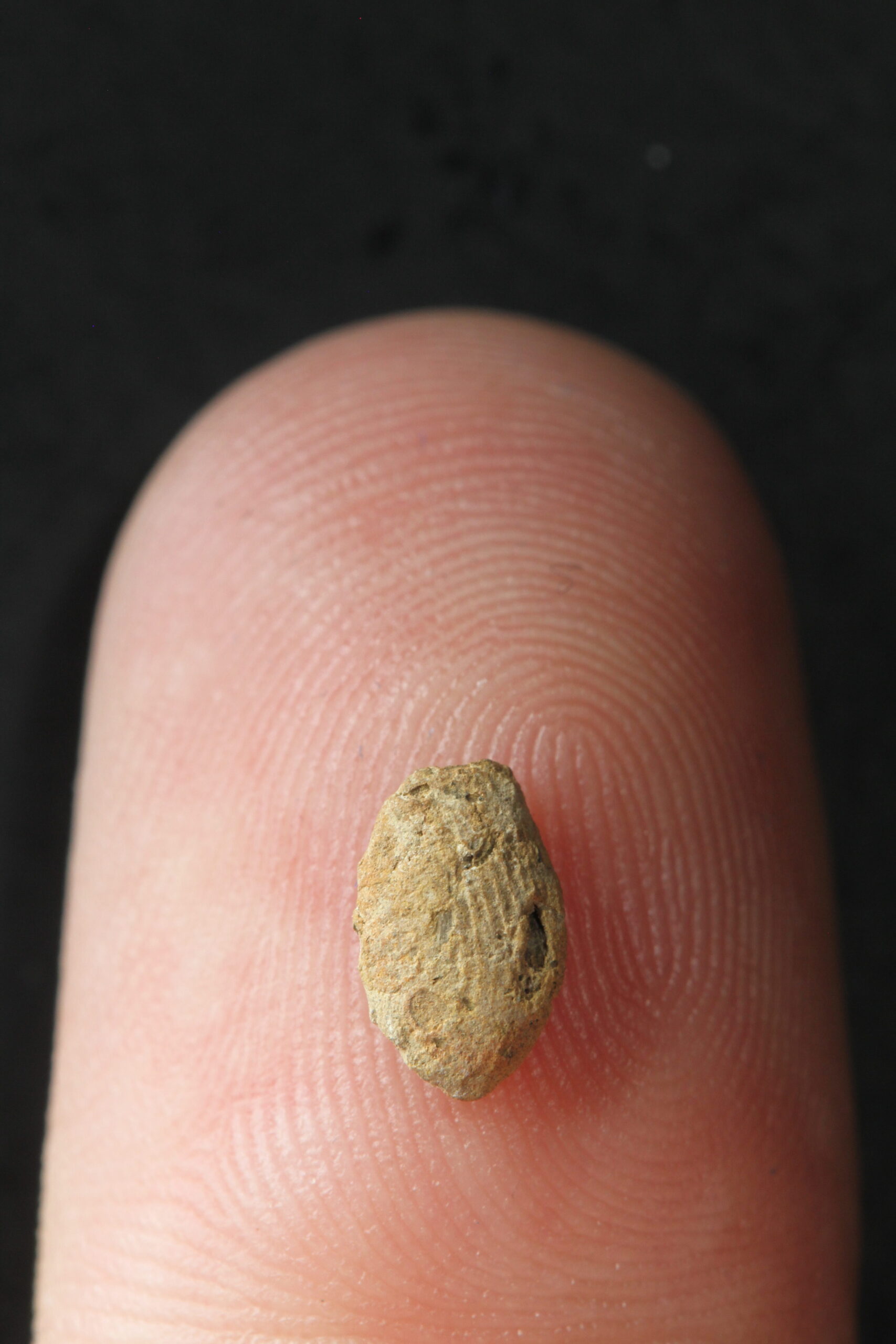
The “butterfly bead” from Eynan-Mallaha (Upper Jordan Valley), colored with red pigment and bearing the fingerprint of a child who shaped it 12,000 years ago. Courtesy Laurent Davin.
For a long time, the story of civilization has sounded straightforward: Humans moved from small, mobile hunter-gatherer groups into settled farming societies during the Neolithic period. Agriculture created surplus, surplus enabled population growth, then specialization, hierarchy, and symbolic culture followed, like crafts and eventually writing. In this model, complexity flows directly from the Agricultural Revolution. A recent study challenges that familiar narrative with some of the smallest artifacts around: beads. In a delightful twist, the research also highlights the role of children in the story of humankind’s development.
The Natufians, living in the Levant roughly 15,000 to 11,650 years ago, occupied the critical threshold just before the Neolithic era, before full-scale farming, domesticated animals, pottery, and permanent villages. Natufians were sedentary or semi-sedentary hunter-gatherers who lived in stone-built settlements rather than the mudbrick structures of later Neolithic villages.
It was in this pre-Neolithic context at the site of Eynan-Mallaha (Upper Jordan Valley) that a remarkable artifact called the “butterfly bead” was created and recently studied by Laurent Davin and colleagues. This bead, along with 141 other personal ornaments from Natufian sites across Israel, reflects intentional design and the transmission of knowledge across generations. Five of the six Natufian clay ornaments that preserved identifiable fingerprints were made by children or adolescents (detected via the density of the fingerprint ridges). Evidently, children and adolescents participated in the creation of beads and pendants, learning and practicing within a multigenerational craft tradition.
Across three regions—Mt. Carmel, the Galilee, and the Upper Jordan Valley—the ornaments share consistent forms, techniques, and pigmentation practices over roughly 3,000 years. Elliptical beads dominate the assemblage, alongside pendants and more complex shapes like the butterfly form. Many of these shapes appear to echo plant forms that structured Natufian subsistence: grains, legumes, and nuts.
Evocatively, the authors call clay a “technology of imagination.” Unlike stone, bone, or shell, clay is not constrained by natural forms, allowing the Natufians to mold abstract shapes and symbolic designs. It was a tool for materializing ideas.

Use-wear analysis shows smoothing around surfaces and perforations (suspension holes) consistent with sustained, repeated wear. Spatial analysis at Eynan-Mallaha places many of them in domestic and work areas—especially near hearths—suggesting they were worn during everyday activities and not reserved for special occasions. In other words, symbolic expression was embedded in daily life.
The beads reveal a surprising level of technical sophistication. About a third were colored with red ochre, a pigment made from grinding hematite into powder. The Natufians applied it in multiple ways: painted onto finished surfaces, mixed directly into the clay, or added as a thin slip (engobe)—the earliest known use of this technique in the Levant. Red ochre presents as a consistent feature across sites, demonstrating both skill and stylistic convention. Many of the beads also show evidence of heating, possibly intentional, hinting at early experimentation with pyrotechnology.
The finds represent the earliest known clay ornamental tradition outside Europe and, unexpectedly, predate the Neolithic period in Southwest Asia. Until now, only a single Natufian clay bead had been identified. What once seemed like a rare curiosity now provides evidence of a larger standing craft tradition. Further, the 142 beads and pendants discovered across Israel outnumber all known clay ornaments from the subsequent Pre-Pottery Neolithic A period across the Levant. Symbolic clay craftsmanship was flourishing among hunter-gatherers thousands of years before the rise of farming.
The implication is hard to ignore—symbolic and social complexity did not follow the Neolithic Revolution; it helped set the stage for it. The Natufians were already building shared visual languages, teaching craft across generations, and engaging in symbolic expression before agriculture took hold.
The study also offers deeper methodological lessons. The artifacts were “hiding” in plain sight, tucked within pounds of unsorted clay fragments collected over decades of excavation. Archaeologists had not been looking for beads and pendants because forgoing evidence said they should not exist. Similarly, the beads challenge the default assumption that complexity only arises from moments of economic or technological boom: Cultural evolution here is not linear. The study also flips the common assumption that “innovation” or “serious work” stems only from adults or specialists.
All told, the research provides fresh grounds to rethink old certainties about how human systems should be interpreted—urging us to remain open to the unexpected, value unconventional contributors, and question simplistic linear narratives.
Lauren K. McCormick is an assistant editor at Biblical Archaeology Review and a specialist in ancient Near Eastern religions, visual culture, and the Bible. She holds degrees in religion from Syracuse University, Duke University, New York University, and Rutgers University, and completed a postdoctoral fellowship on religion and the public conversation at Princeton University.
Become a BAS All-Access Member Now!
Read Biblical Archaeology Review online, explore 50 years of BAR, watch videos, attend talks, and more

Related reading in Bible History Daily
12,000-Year-Old Shaman Funeral Reflects Natufian-Period Changes
All-Access members, read more in the BAS Library
Not a BAS Library or All-Access Member yet? Join today.
The post What Role Did Children Play in the Rise of Civilization? appeared first on Biblical Archaeology Society.
Comments
Post a Comment