
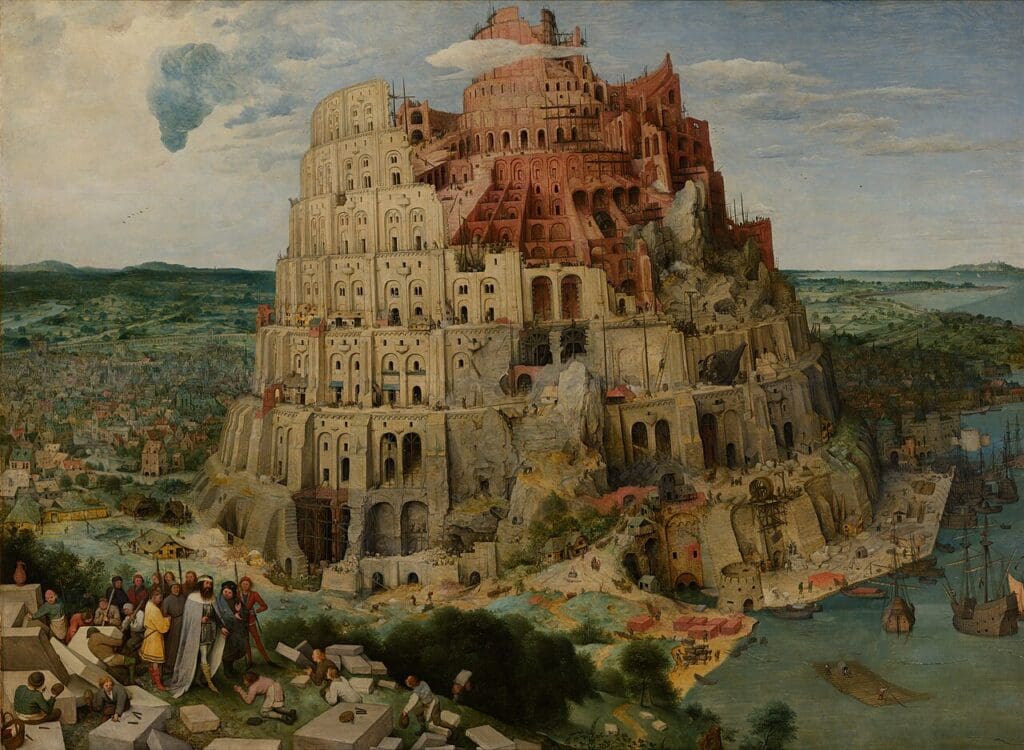
The Tower of Babel by Pieter Bruegel the Elder, 1563. Public domain, via Wikimedia Commons.
The story of the Tower of Babel in Genesis 11 is nine verses long. You can read it in under a minute. Yet few biblical passages have exercised such a lasting hold on the imagination as this one. It has inspired famous works of art, most memorably the towering spirals painted by Pieter Bruegel the Elder in the 16th century (see above). It has even shaped everyday language: English “babble” evokes nonsensical speech, a connection reinforced by the Latin Vulgate’s rendering of the city as Babel. The story has also sent archaeologists digging for the real tower in Babylon.
This text punches far above its weight, perhaps because it mystifies. Why were the builders wrong? Their stated motivation was to avoid being scattered, which is hardly a moral outrage. The text never calls them wicked. God’s own explanation is surprisingly difficult to pin down. In Genesis 11:6, God observes that if humanity remains united, “nothing they plan to do will be impossible for them,” a remark that seems to signal divine anxiety. God then intervenes, confusing their language and dispersing the humans across the world. For centuries, popular opinion has held a straightforward explanation: Human pride pushed too far and God stepped in.
Now, an article by scholars Matthieu Richelle and David S. Vanderhooft in the Spring 2026 issue of Biblical Archaeology Review raises yet another unsettling question: What if the Tower of Babel actually was finished? The evidence, they argue, has been hiding in plain sight in the grammar of the text. The debate hinges on how to render the Hebrew verb in Genesis 11:5. “Were building” (NIV) implies ongoing construction, while “had built” (NRSV) implies it was already done. The authors argue that the Hebrew syntax supports translation into the pluperfect “had built.” In other words, the text envisions a tower that was fully built before God intervened.
The logic of the narrative itself lends some support to this interpretation. A few verses later, the text explains that once the languages were confused, the people “stopped building the city”—not the tower, the city.
It’s a narrow argument, but, if correct, one that subtly shifts how the story works. An unfinished tower fits comfortably with the traditional reading of the story as a warning against pride. Humanity attempts to reach the heavens, and God intervenes before they succeed. But if the tower was already complete, the story becomes less about preventing human overreach and more about reacting to it. That changes God’s positionality quite a bit.
In Genesis 11:6, God remarks that, if humanity remains united, “nothing they plan to do will be impossible for them.” Humans present as extraordinarily powerful when acting with a single purpose.

Ancient interpreters were already aware that the Tower of Babel raises uncomfortable questions. One medieval Jewish text, the Midrash Tanhuma, explicitly argues that God allowed the tower to be completed precisely to show that God was not threatened by it. If the tower had remained unfinished, the builders might have claimed they would have succeeded, given more time. The fact that commentators felt compelled to make this point suggests a kind of defense of God’s omnipotence. Does the narrative portray God as threatened by humankind?
Interpreters have long tried to settle the story by identifying the builders’ mistake. Besides the familiar explanation of the tower as a symbol of human pride, or the concern God voices over unified human action, others see a problem of disobedience: Humanity had previously been instructed to fill the earth (Genesis 1:28), yet the builders sought to gather and settle. Others read the episode as a quiet critique of empire, evoking the centralized power and monumental architecture of Babylon, like the historic temple tower Etemenanki that was found there. More symbolically inclined readings even linger on the attention to materials in Genesis 11:3, where the use of mudbrick over stone is referenced, hinting at a world too thoroughly reshaped by human design. Still others, meanwhile, treat the narrative primarily as an origin story or etiology, explaining why humankind is divided into different languages and cultures. Each of these readings clarifies something, but none fully resolves the story’s tensions.
In nine brief verses, the Tower of Babel story raises questions about unity, hubris, empire, and human potential that go unresolved. Richelle and Vanderhooft’s theory that the tower was actually finished does not so much solve the mystery as deepen it. That lingering ambiguity may not be a problem to fix, but part of what has kept readers returning to the text for thousands of years.
For more on how interpreters have understood the Tower of Babel story, read Matthieu Richelle and David S. Vanderhooft’s article “Was the Tower of Babel Left Under Construction?” published in the Spring 2026 issue of Biblical Archaeology Review.
Lauren K. McCormick is an assistant editor at Biblical Archaeology Review and a specialist in ancient Near Eastern religions, visual culture, and the Bible. She holds degrees in religion from Syracuse University, Duke University, New York University, and Rutgers University, and completed a postdoctoral fellowship on religion and the public conversation at Princeton University.
Become a BAS All-Access Member Now!
Read Biblical Archaeology Review online, explore 50 years of BAR, watch videos, attend talks, and more

Related reading in Bible History Daily
Huqoq 2017: Mosaics of Jonah and the Whale, the Tower of Babel and More
All-Access members, read more in the BAS Library
The Sources of Genesis 1–11 According to the Documentary Hypothesis
Not a BAS Library or All-Access Member yet? Join today.
The post Why the Tower of Babel Is So Hard to Explain appeared first on Biblical Archaeology Society.
Comments
Post a Comment