
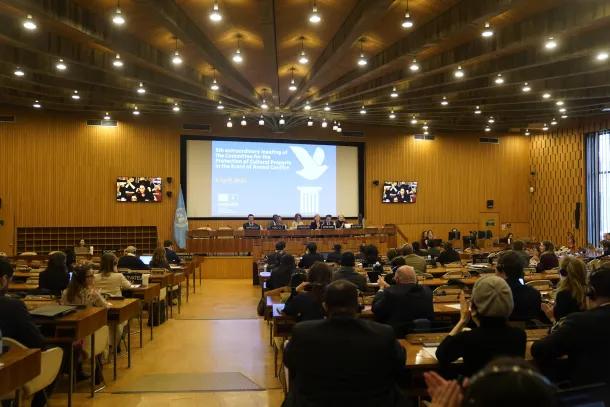
UNESCO meeting of the Committee for the Protection of Cultural Property in the Event of Armed Conflict (April 1, 2026). Courtesy UNESCO.
In a decision prompted by a request from the Lebanese government, UNESCO granted enhanced protection status to 39 sites across Lebanon under the 1954 Hague Convention for the Protection of Cultural Property in the Event of Armed Conflict. The designation places these sites under the highest level of legal safeguarding during armed conflict, meaning that any intentional damage could be considered a war crime. UNESCO has committed over US$100,000 for measures on the ground, including training for staff and military personnel.
Included in the press release is a quotation from Lazare Eloundou Assomo, UNESCO’s acting Assistant Director-General for Culture: “Cultural heritage must be protected. It is the backbone of people’s identity, trust and hope, and it carries the promise of peace and recovery. When heritage is destroyed anywhere, moral standards are undermined, social cohesion is eroded, and trust and resilience are jeopardized.”
Amid heightened regional tensions, the move is widely understood as a proactive effort to safeguard Lebanon’s heritage from the threat of escalating conflict. Yet beyond its legal and geopolitical dimensions, this decision highlights the enduring global significance of Lebanon’s past.
For those interested in biblical history, Lebanon holds a special place. The area’s natural resources played a direct role in one of the Bible’s most iconic building projects: According to 1 Kings, the famed cedars of Lebanon were used to construct Solomon’s Temple. Ancient cities along Lebanon’s coast, such as Tyre and Sidon, were central to the Phoenicians, who were renowned seafarers and traders in the biblical world. Both cities also appear as powerful maritime centers in the Hebrew Bible and New Testament. The Gospels recount that Jesus also traveled in their vicinity (e.g., Matthew 15:21–28). Such references correspond to real locations whose archaeological remains still stand today. For archaeologists and historians, these sites provide crucial context, helping to illuminate the political, economic, and cultural environment in which biblical narratives unfolded.
Lebanon’s significance extends far beyond its role in biblical history, however. Its lands have been a crossroads of civilization for millennia, shaped by trade, migration, and cultural exchange long before and alongside the rise of empires—Assyrian, Babylonian, Persian, Greek, Roman, and Ottoman. Phoenician innovations, including the spread of alphabetic writing, revolutionized human communication. Lebanon has witnessed the development of early Christianity, vibrant Islamic cultures, and the enduring contributions of many other communities, such as the Druze. Lebanon’s rich and diverse past offers profound testament to human creativity and interconnectedness; this long history belongs to the people of Lebanon, but it also resonates globally.
One of the UNESCO-protected sites, the city of Tyre, has withstood centuries of conflict. Famous for enduring sieges by Nebuchadnezzar (early sixth century BCE) and Alexander the Great (late fourth century BCE), its ruins bear witness to both devastation and resilience across generations. Protecting Tyre means preserving the stories, identities, and memories of those who are connected to it, while also offering an opportunity to confront—and, ideally, learn from—the enduring consequences of war. War does not only erode cultural sites; it also erodes the connections people feel toward each other. The call, then, is not just to protect Lebanon’s heritage, but to cultivate empathy in the face of war—to recognize Lebanon’s history, as indeed anyone’s, as all of ours.
Lauren K. McCormick is an assistant editor at Biblical Archaeology Review and a specialist in ancient Near Eastern religions, visual culture, and the Bible. She holds degrees in religion from Syracuse University, Duke University, New York University, and Rutgers University, and completed a postdoctoral fellowship on religion and the public conversation at Princeton University.
Become a BAS All-Access Member Now!
Read Biblical Archaeology Review online, explore 50 years of BAR, watch videos, attend talks, and more

Related reading in Bible History Daily
All-Access members, read more in the BAS Library
Not a BAS Library or All-Access Member yet? Join today.
The post 39 Sites in Lebanon Gain UNESCO Protection appeared first on Biblical Archaeology Society.
Comments
Post a Comment