
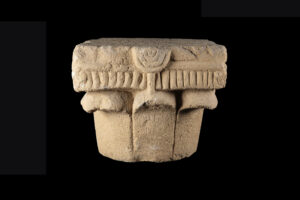
The stone capital from Moza with a carved menorah. Courtesy Arkady Ostrovsky, IAA
While carrying out salvage excavations in the modern town of Moza, just outside of Jerusalem, archaeologists with the Israel Antiquities Authority (IAA) uncovered a unique find: a stone capital featuring an eight-branched menorah. Found in secondary use in a Byzantine settlement, the capital presents archaeologists with an intriguing conundrum: How did a Jewish symbol end up in a village settled by the descendants of Roman soldiers?

Carving a Capital
Made of limestone, the capital was discovered top down in the remains of a Byzantine-period building that dates to the sixth or seventh century CE. Carved in the upper section of the capital were four eight-branched menorahs, one on each side. Below that were eight leaves, carved side by side, encircling the base of the capital.
According to Orit Peleg-Barkat, an archaeologist from the Hebrew University of Jerusalem, “While Corinthian capitals with smooth leaves were common throughout our region from the late Second Temple through Byzantine periods, the capital discovered at Moza exhibits truly distinctive features. Despite being skillfully crafted, it appears to be the work of an artisan less familiar with architectural conventions prevalent in urban public structures. Most significantly, the upper section—traditionally adorned with a floral motif—instead features what resembles an eight-branched menorah.”
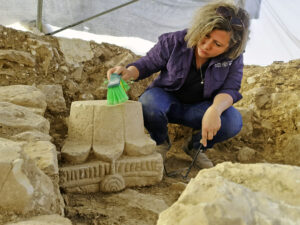
Cleaning the capital after its discovery. Courtesy Photo Yoli Schwartz, IAA.
Despite its discovery in a Byzantine building, the capital was likely first used as an architectural element in an earlier Roman-period building, dating to the second through fourth centuries. During both the late Roman and Byzantine periods, capitals featuring the menorah were commonly used in synagogues, such as those discovered at Capernaum and Caesarea. This raises the interesting question of where the capital actually originated.
Despite the capital’s limestone being common to the area around Jerusalem, it is unlikely to have been produced in Moza, as no evidence for a Jewish population—let alone the existence of a synagogue—has been found there. Indeed, the site appears to have been settled by retirees from the Roman army, perhaps even some who fought in the many conflicts with the region’s Jewish population in the first and second centuries. These conflicts culminated with the Bar-Kokhba Revolt (132–135 CE), which saw much of the Jewish population of Judea driven from the region. “It is reasonable to surmise,” said IAA Deputy Director Yuval Baruch, “that this capital was brought from a destroyed site elsewhere merely to serve as useful building material here, in secondary usage.”
This article was first published in Bible History Daily on May 2, 2025.
Become a BAS All-Access Member Now!
Read Biblical Archaeology Review online, explore 50 years of BAR, watch videos, attend talks, and more

Related reading in Bible History Daily
All-Access members, read more in the BAS Library
Not a BAS Library or All-Access Member yet? Join today.
The post A Capital Conundrum appeared first on Biblical Archaeology Society.
Comments
Post a Comment