
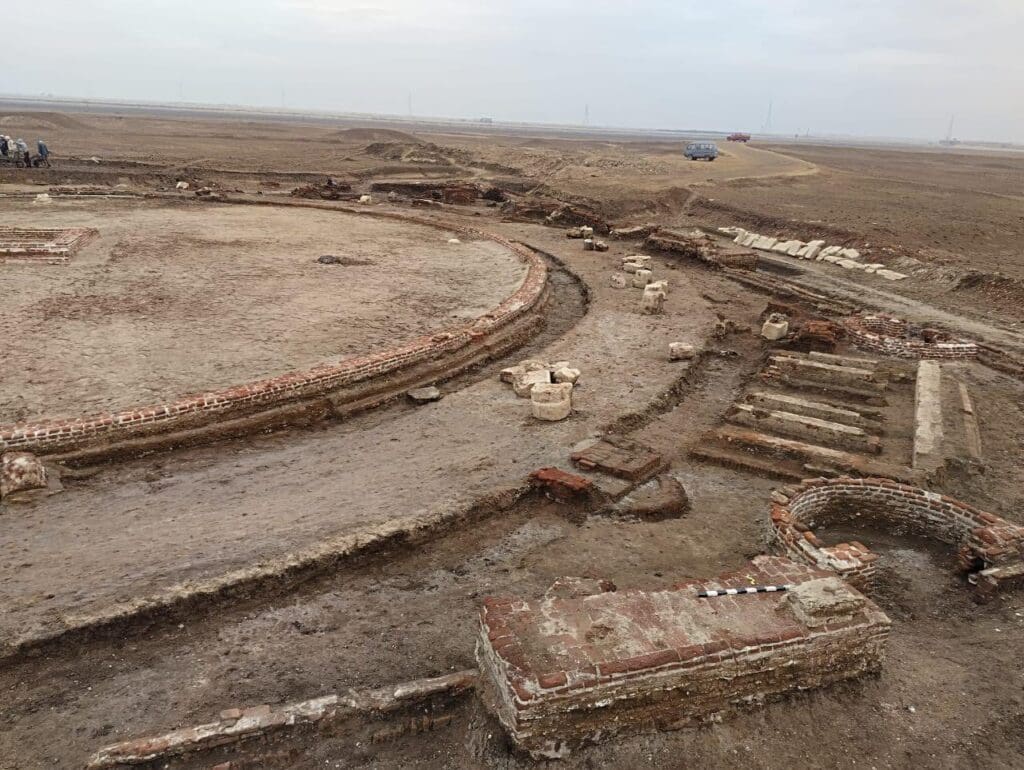
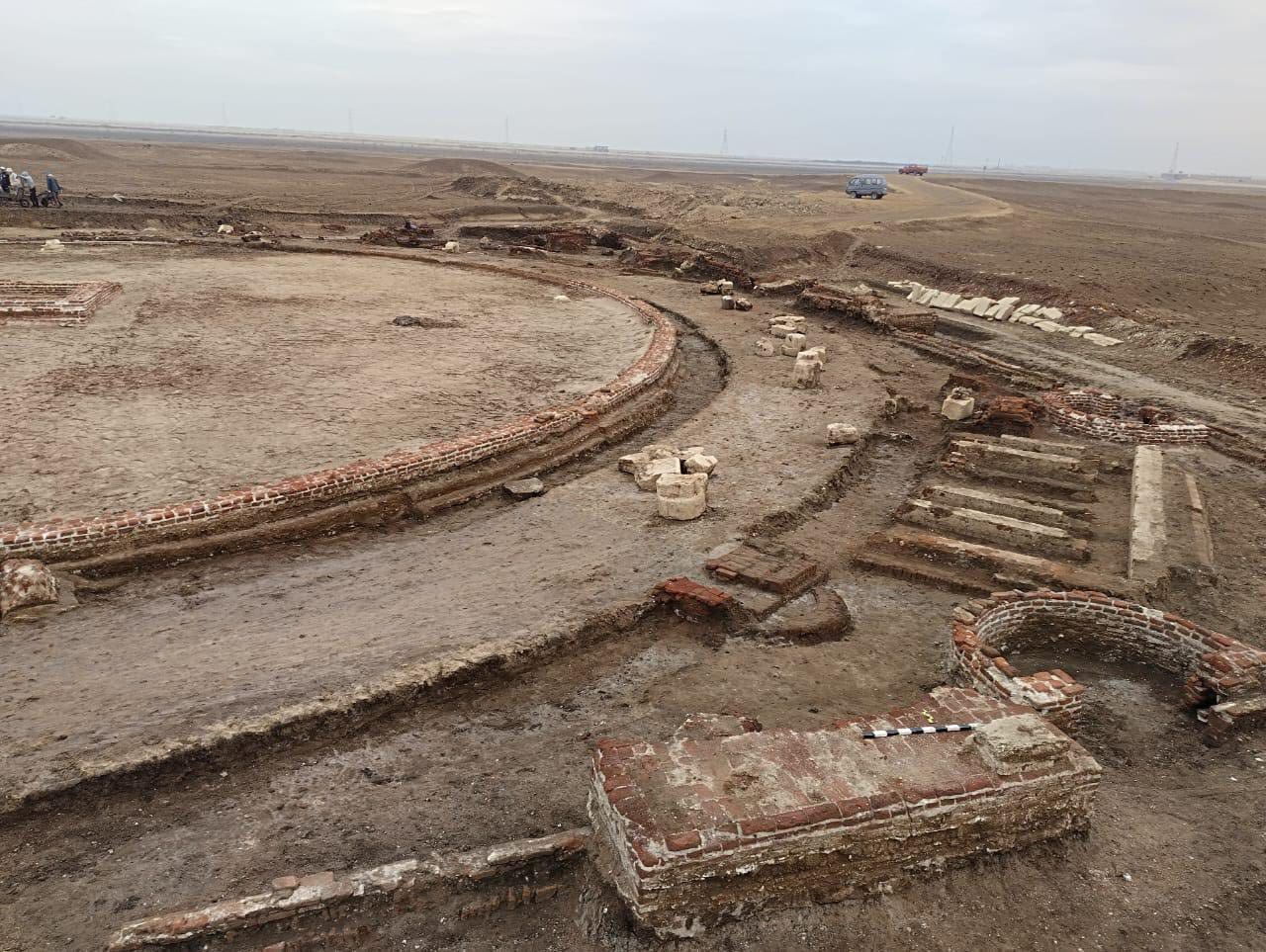
Circular basin and surrounding structures found at Tell el-Farama (ancient Pelusium) in northern Sinai. Courtesy Egyptian Ministry of Tourism and Antiquities.
As announced on social media by Egypt’s Ministry of Tourism and Antiquities, a large circular structure—about 115 feet in diameter—has been uncovered in northern Sinai at Tell el-Farama (ancient Pelusium). When excavation began in 2019, archaeologists thought the basin and surrounding remains might belong to a civic structure, possibly a council building. However, as excavation progressed, the team identified a system of channels associated with the basin and a direct connection to a branch of the Nile. These channels were designed to bring in, circulate, and drain river water in a controlled system. The archaeologists suggest that a square platform at the center of the basin may have supported a statue or cult object. Now understood as a ritual water complex, the building was in use from roughly the second century BCE to the sixth century CE.
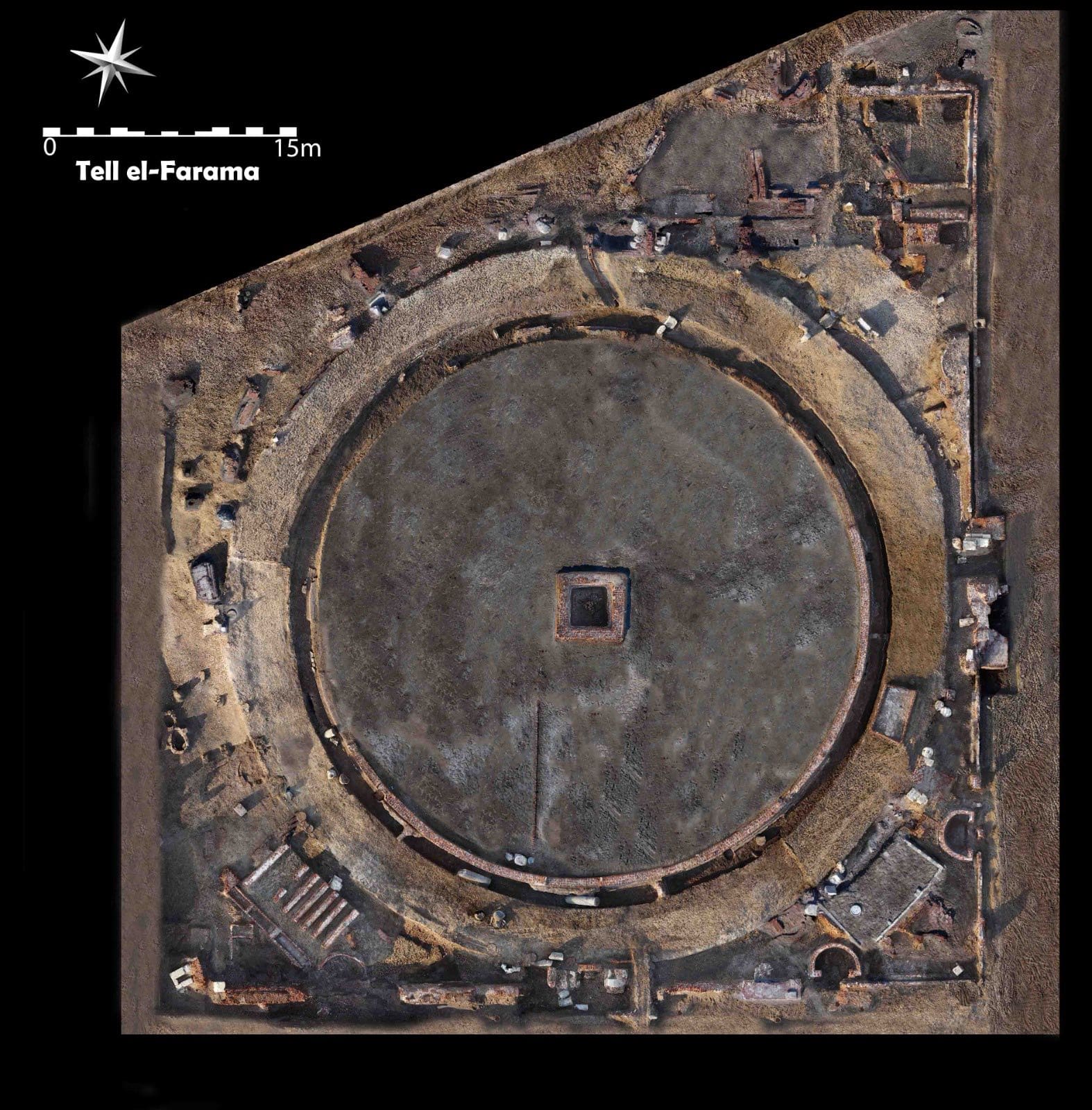
Aerial view of the central podium, circular basin, and surrounding structures found at Tell el-Farama (ancient Pelusium) in northern Sinai. Courtesy Egyptian Ministry of Tourism and Antiquities.
The structure was built using fired red brick rather than sun-dried mudbrick, which is especially important for a building designed to handle water. In Egypt, red brick began to appear in a limited and specialized way during the pharaonic period, but became more common in hydraulic construction during the Hellenistic period (after the fourth century BCE) and especially under Roman rule (from 30 BCE onward).
Pelusium stood on the easternmost branch of the Nile—now long dried—known as the Pelusiac branch. It formed a natural corridor linking the Nile Valley with the Sinai frontier and onward toward Canaan, functioning as a kind of gateway zone where people, goods, and ideas moved between Egypt and the Levant. For travelers arriving from the Sinai desert, this Nile branch would have been their first encounter with river water, perhaps marking a symbolic threshold between arid wilderness and the river-fed Nile Valley.
In ancient Egyptian religion, the Nile was understood as the source of life, fertility, and divine order. Its annual flooding renewed the land and symbolized cosmic balance. By channeling Nile water into a controlled architectural space, possibly with a religious icon at its center, the builders seem to have made the Nile’s life-giving force ritually available. “Living” water from the Nile was central to Egyptian purification rituals, offerings, and ceremonies. Though it contains still as opposed to flowing water, the Karnak Temple complex famously contains a “sacred lake” inside.
By the time the circular complex went out of use in the sixth century, the religious landscape of Egypt had changed significantly, with Christianity firmly established and monastic communities expanding across regions such as Sinai. Yet the long duration of the site’s use points to continuity in how water was understood as a carrier of ritual and symbolic meaning.
In the book of Exodus, water plays a central role in divine action, from the first plague where Nile water turns to blood to the crossing of the sea. In later Jewish tradition, ritual immersion becomes central in mikveh practices. In Christianity, water comes to symbolize rebirth, purification, and spiritual transformation. Pelusium thus offers a concrete example of how water, especially Nile water, could be harnessed and ritually activated. It underscores the enduring religious significance of water in the eastern Mediterranean world.
Lauren K. McCormick is an assistant editor at Biblical Archaeology Review and a specialist in ancient Near Eastern religions, visual culture, and the Bible. She holds degrees in religion from Syracuse University, Duke University, New York University, and Rutgers University, and completed a postdoctoral fellowship on religion and the public conversation at Princeton University.
Become a BAS All-Access Member Now!
Read Biblical Archaeology Review online, explore 50 years of BAR, watch videos, attend talks, and more

Related reading in Bible History Daily
All-Access members, read more in the BAS Library
Not a BAS Library or All-Access Member yet? Join today.
The post Circular Water Complex Discovered on the Edge of the Ancient Nile appeared first on Biblical Archaeology Society.
Comments
Post a Comment