
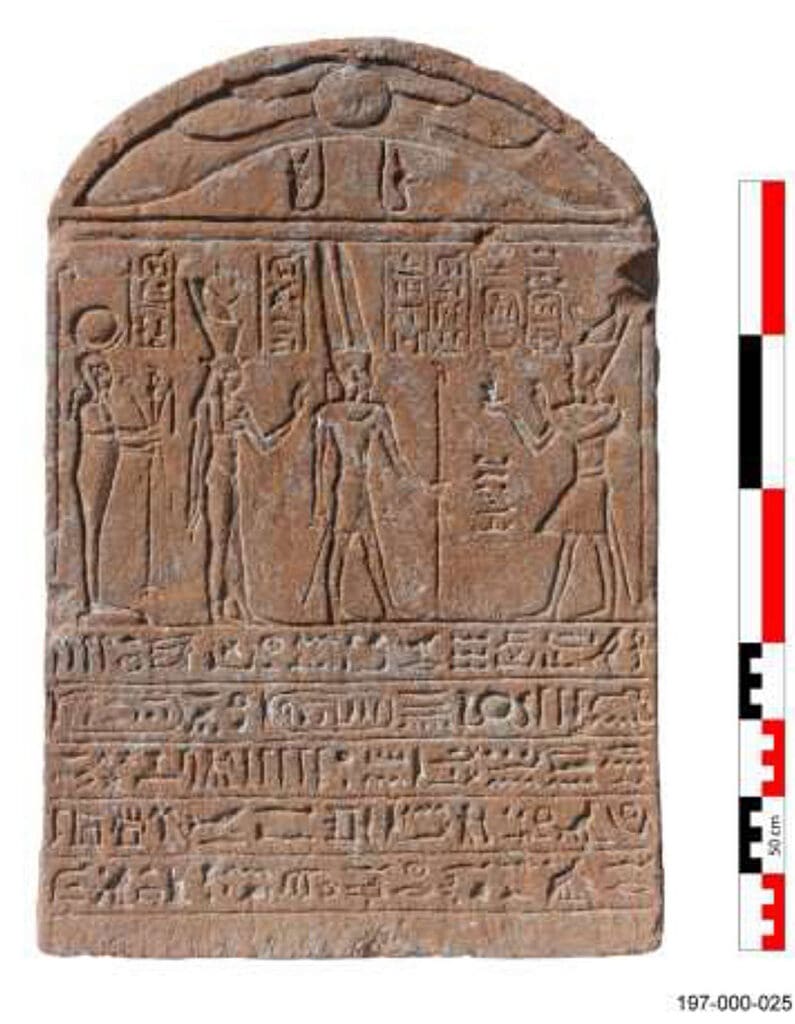
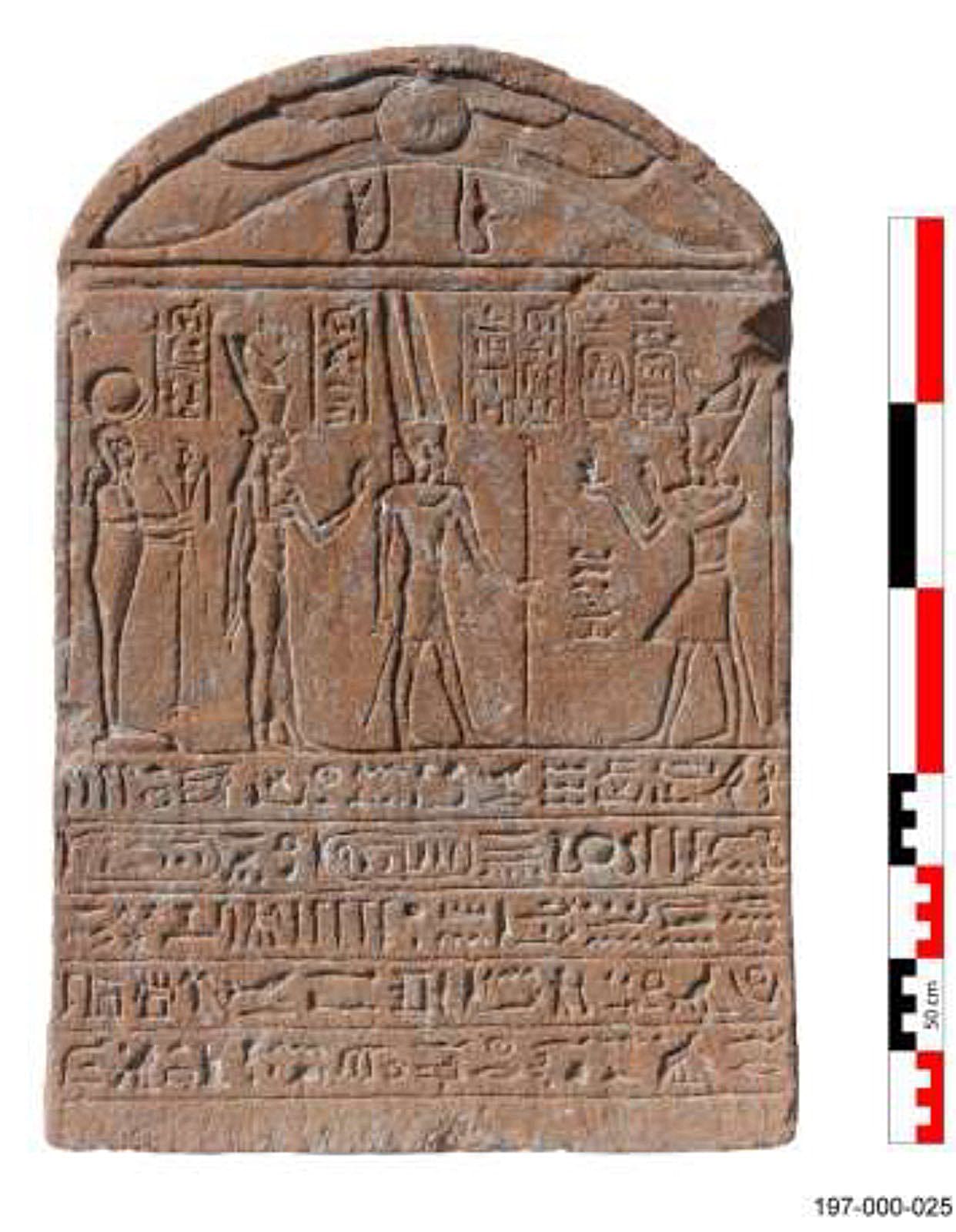
Stela depicting the Roman emperor Tiberius as an Egyptian pharaoh before the gods Amun, Mut, and Khonsu. Photo courtesy the Egyptian Ministry of Tourism and Antiquities.
Recent restoration efforts by the Egyptian-French Center for the Study of the Temples of Karnak (CFEETK) have revealed an intriguing discovery—a sandstone stela depicting the Roman emperor Tiberius in full Egyptian regalia. Ruling between 17 and 37 CE, Tiberius was emperor at the time of Jesus’s crucifixion and the early days of the Jesus movement.
Measuring approximately 2 feet tall, the monument depicts Tiberius standing with the Egyptian gods known as the Theban triad: Amun, Mut, and Khonsu. Below the scene are five lines of hieroglyphic text documenting the restoration of a retaining wall within the sacred temple complex of Karnak.

Depictions of Roman emperors in Egyptian regalia are rare, signifying the stela’s importance. Amun, a major Egyptian deity often merged with the sun god Ra, was a divine sky-father associated with truth and justice and who brought order from chaos. Alongside his consort Mut, a primordial mother-goddess, and their son Khonsu, a moon-god who represented death and rebirth, the Theban triad were keepers of the cosmic order, the cycles of fertility, and Ma’at—the ordered balance of nature central to the Egyptian worldview.
Arguably, the Egyptian pharaoh’s most important job was to uphold Ma’at to ensure the land’s prosperity. Impious kings who shirked their sacred duties were thought to bring about various disasters, including famine, pestilence, and military defeat. They also tended to be quickly replaced. As the ruler of Egypt, Emperor Tiberius was expected to uphold Ma’at like his ancient forebears. By depicting himself as a pharaoh and appeasing the Theban triad, Tiberius honored the ancient ways in order to ensure the prosperity of this important Roman province.
To better understand the historical world behind the Bible, read the free eBook Biblical Peoples: The World of Ancient Israel, which explores the major cultures that shaped ancient Israel. What do archaeology and ancient texts reveal about Israel's neighbors the Egyptians, Assyrians, Canaanites, Philistines, Edomites, and more?
Tiberius’s cultural piety likely had many layers, including quelling possible political unrest. Paying homage to the gods of Egypt and maintaining Ma’at also helped to ensure the fertility of the land, which was crucial for the survival of the Roman empire. Known as one of the “breadbaskets of Rome,” Egypt’s relatively stable supply of grain kept the peoples of the ever-growing Empire fed and happy. If the gods of Egypt were displeased, disaster might strike the fertile lands of the Nile, which, in turn, would have devastating effects across the empire.
The stela was found during restoration efforts to a much earlier gateway dated to the reign of Ramesses III (c. 1186–1155 BCE), who famously repelled the invading forces of the “Sea Peoples” in the 12th century BCE. Interestingly, these constructions reused even earlier materials dated to the reign of the 18th Dynasty pharaoh Amenhotep III (c. 1388–1351 BCE), father of the heretic king and monotheist Akhenaten, signifying the importance of the site throughout Egyptian history. Evidence of restoration efforts during the Greek and Roman periods was also found, which no doubt included renovations by Tiberius, commemorated by the newly discovered stela.
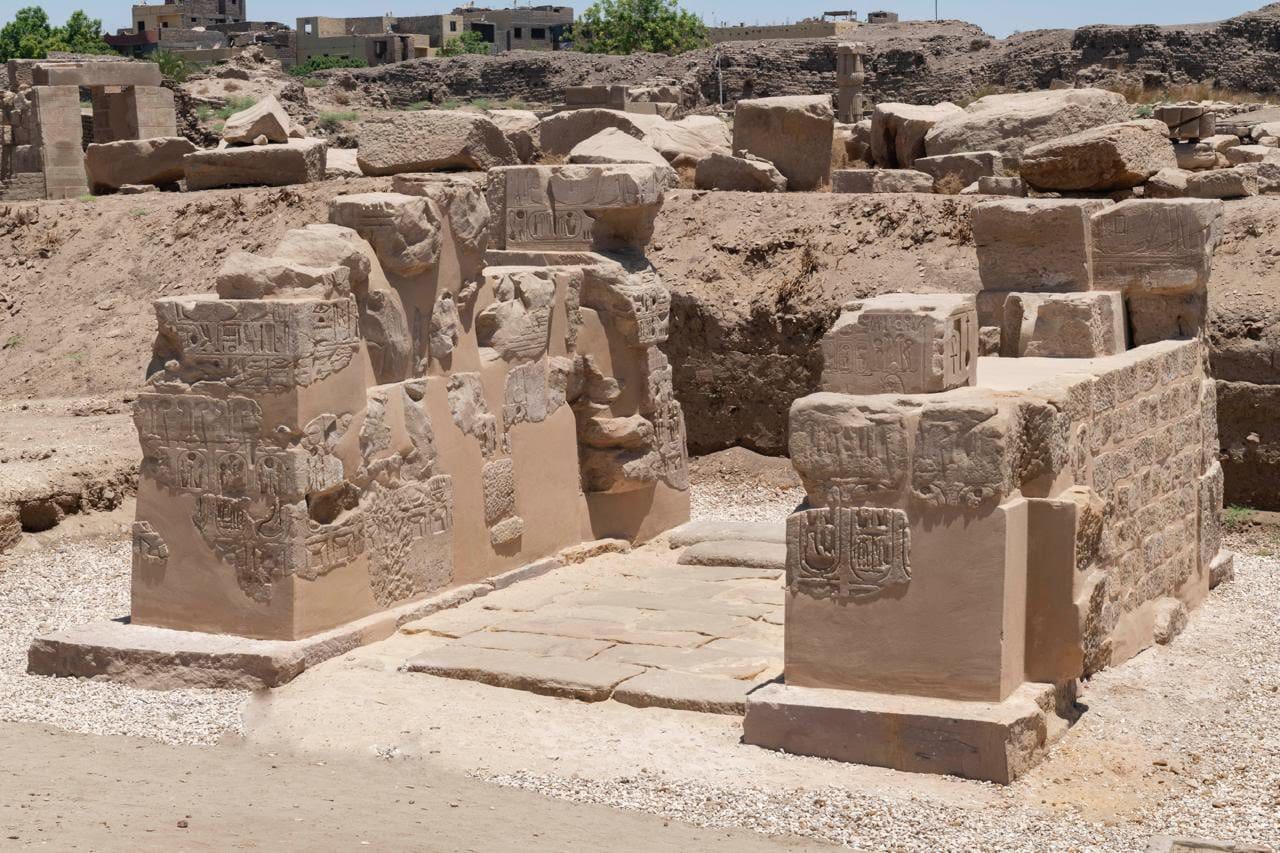
Restored gateway from the time of Ramesses III (c.1186–1155 BCE). Photo courtesy the Egyptian Ministry of Tourism and Antiquities.
According to Abdel Ghaffar Wagdy, Director General of Luxor Antiquities and head of the Egyptian mission, the stela underwent meticulous restoration and maintenance work by the CFEETK team and will eventually be displayed in one of the country’s museums.
Sherif Fathy, Egypt’s Minister of Tourism and Antiquities, praised the fruitful joint efforts of the French-Egyptian team, which are part of an ongoing project within the Karnak temple complex to enhance the tourist experience, including the construction of an open-air museum.
Become a BAS All-Access Member Now!
Read Biblical Archaeology Review online, explore 50 years of BAR, watch videos, attend talks, and more

Related reading in Bible History Daily
All-Access members, read more in the BAS Library
Between Moses and the Ancestors: Israelite Religion in Egypt
Losing Abraham’s Religion: More on Israelite Religion in Egypt
Not a BAS Library or All-Access Member yet? Join today.
The post Egyptian Stela Depicts Emperor Tiberius as Pharaoh appeared first on Biblical Archaeology Society.
Comments
Post a Comment