
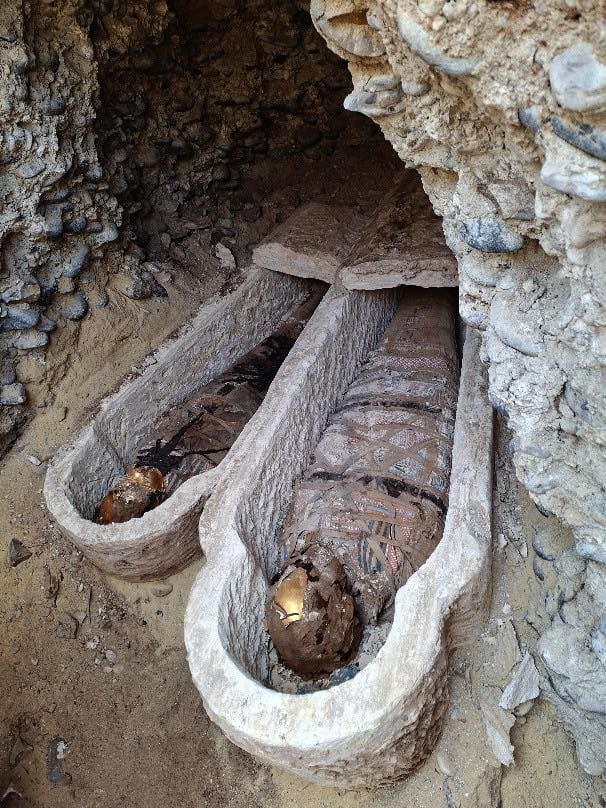
Roman-era mummified individuals inside wooden coffins, found in the Minya region of Egypt. Courtesy the Egyptian Ministry of Tourism and Antiquities.
A recent press release from the Egyptian Ministry of Tourism and Antiquities announced striking archaeological discoveries in the Minya region of Egypt. A Roman-era underground burial chamber was found at ancient Al-Behansa (Oxyrhynchus) containing coffins, mummified humans, and several golden tongues placed inside the mouths of the dead. Nearby were cremation burials involving adult, children, and seagull bones, terracotta and bronze figurines, and, remarkably, a fragment from Homer’s Iliad.
The mummified individuals were wrapped in cloths with geometric patterns before being placed in wooden coffins. Among the most striking finds were three gold tongues and one brass tongue, each crafted from thin foil and carefully positioned in the mouths of the deceased. Similar finds have been previously reported from Oxyrhynchus, as well as from Roman-period burials at Taposiris Magna in northern Egypt.
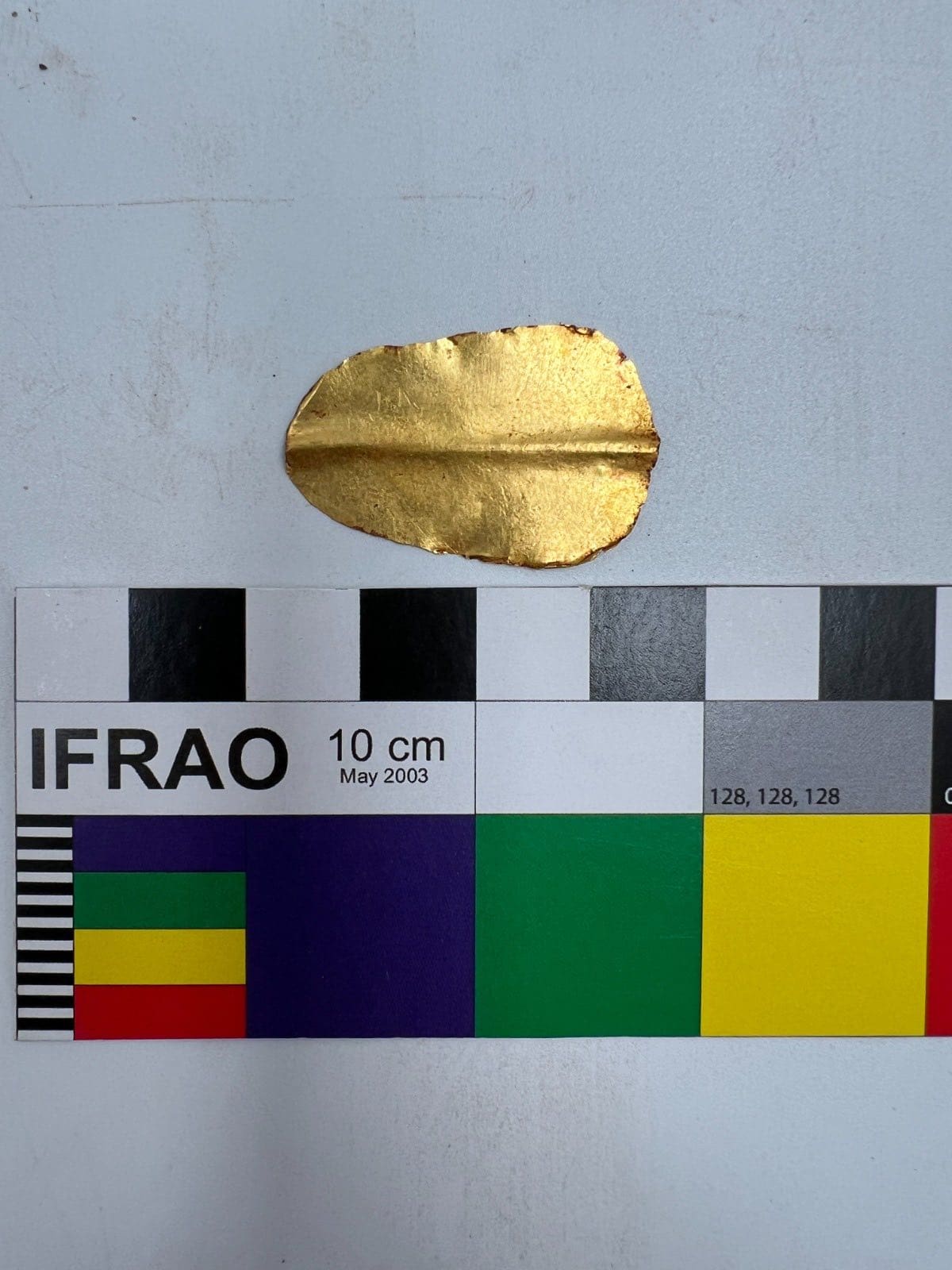
One of three Roman-era gold tongues found in the Minya region of Egypt. Courtesy the Egyptian Ministry of Tourism and Antiquities.
In Egyptian religious thought, especially in traditions linked with the god Osiris, the deceased were expected to speak, justify themselves, and participate in judgment. The tongues are generally interpreted as enabling this capacity for speech in the afterlife. Rituals like the “Opening of the Mouth” ceremony symbolically restored speech and other senses to the dead, and the persistence of this practice into the Greco-Roman period highlights how rooted it remained within a changing cultural world. Throughout antiquity, the Egyptian dead were believed to retain identity and to continue to function after death.
This worldview contrasts somewhat with biblical understandings of death. In the Hebrew Bible, death is often associated with silence and diminished agency—a dark and shadowy kind of existence (consider, for example, the Rephaim). The dead in Sheol are not depicted as regularly interacting or speaking in the world of the living. Interestingly, there are exceptions. In 1 Samuel 28, the medium of Endor summons the prophet Samuel from death to prophesy. Necromancy is not sanctioned in this text, but the episode nevertheless reflects a belief in some vitality of the dead. Consulting the dead is forbidden by royal decree, yet the king himself breaks this rule in 1 Samuel 28, to great affect (Samuel speaks!).

In terms of archaeology, burial customs in ancient Israel and Judah were generally much simpler than those seen in Egypt. Iron Age Judahite burials typically involved rock-cut family tombs, where bodies were placed on benches and, after decomposition, the bones were collected within the tomb. These burials were sometimes accompanied by modest grave goods such as pottery vessels (holding food and drink?), oil lamps, and occasional personal items like jewelry. The objects appear to reflect honor, memory, and daily life. Do they also indicate provisions for, and/or interactions with, the dead? This is less clear for Israel than Egypt but texts like Ezekiel 32:27—which mentions warriors buried with weapons—may support this line of inquiry.
During the Second Temple period, Jewish burial practice involved the widespread use of ossuaries—stone boxes for the bones to be gathered after the bodies had decomposed. These containers sometimes preserved the names of the deceased. Early Christian burial practices, which become detectable after the end of the Second Temple period (70 CE), continue the trend of relatively simple interment, with increasing emphasis on bodily resurrection rather than material provision for the dead. Compared with Egyptian burials, the archaeological record of the biblical lands shows far fewer objects intended to accompany or assist the dead in an ongoing afterlife.
The discovery of the Iliad fragment adds another layer of intrigue. The “Catalogue of Ships” (Book 2) excerpt preserves the names, places, and identities of those in a Greek coalition against Troy. Attributed to Homer, the epic is deeply concerned with mortality, fame, and memory. Its heroes confront death while seeking a form of glory that lives on through story. Indulging a connection, the presence of this text near the Al-Behansa burial suggests that, alongside traditional preparations enabling the deceased to speak, there was also the hope that the living would in-turn speak the memory of those individuals into eternity.
Lauren K. McCormick is an assistant editor at Biblical Archaeology Review and a specialist in ancient Near Eastern religions, visual culture, and the Bible. She holds degrees in religion from Syracuse University, Duke University, New York University, and Rutgers University, and completed a postdoctoral fellowship on religion and the public conversation at Princeton University.
Become a BAS All-Access Member Now!
Read Biblical Archaeology Review online, explore 50 years of BAR, watch videos, attend talks, and more

Related reading in Bible History Daily
All-Access members, read more in the BAS Library
Not a BAS Library or All-Access Member yet? Join today.
The post Gold Tongues Discovered on Egyptian Mummies appeared first on Biblical Archaeology Society.
Comments
Post a Comment