
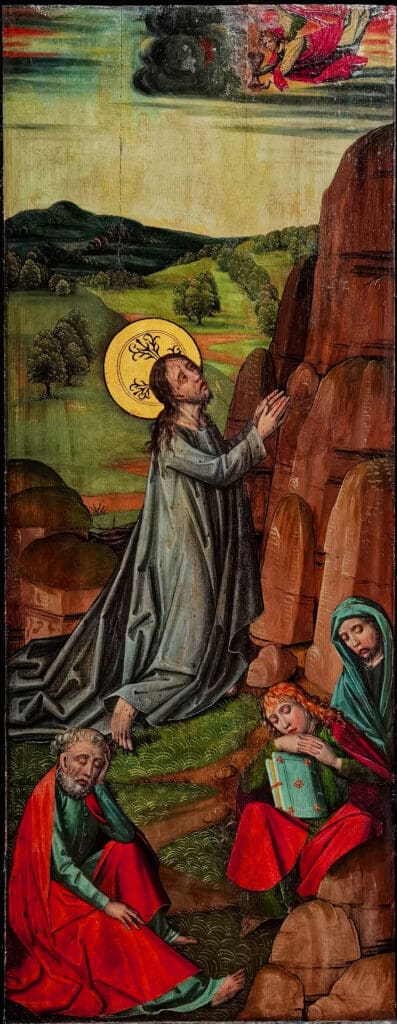
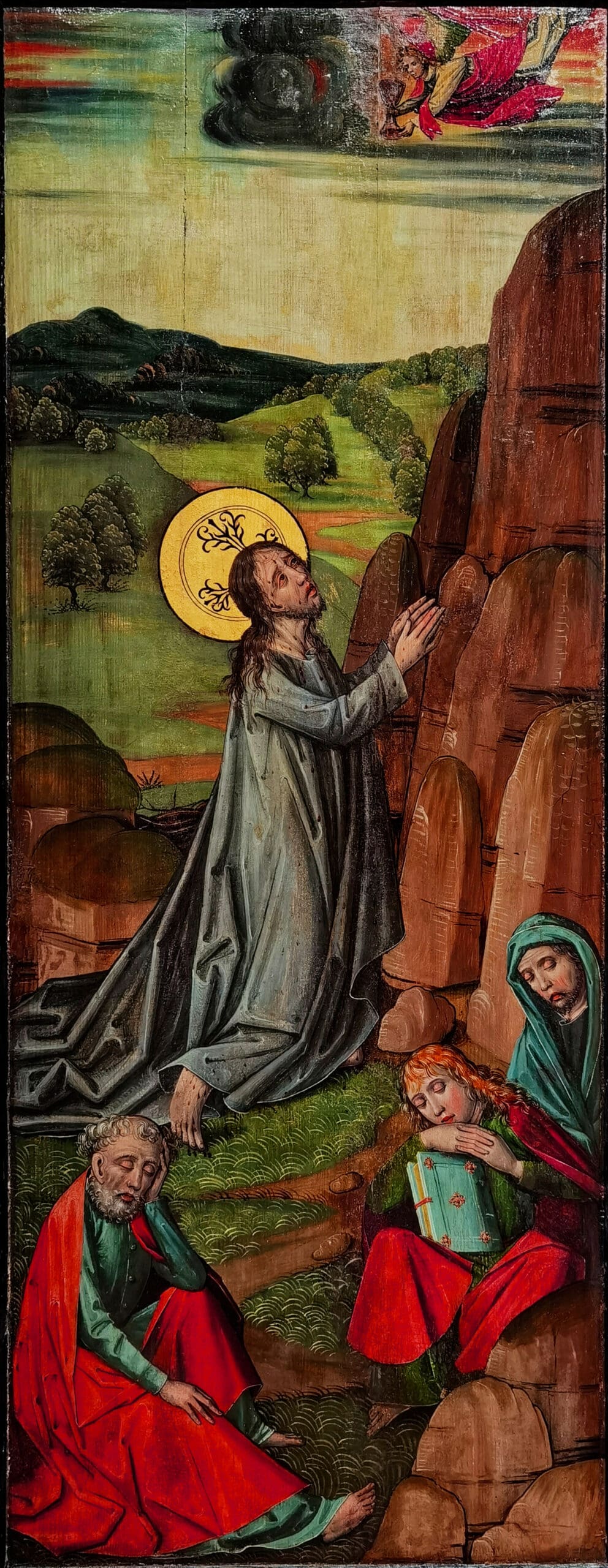
“Agony in the Garden of Gethsemane” by anonymous (ca. 1480 CE), originally presented as a diptych with “Mocking of Christ.” Courtesy Colmar, CC BY-SA 4.0, via Wikimedia Commons.
Matthew 26:39 records that, on the night before his crucifixion, Jesus prays in Gethsemane: “My Father, if it is possible, let this cup pass from me; yet not what I will, but what you will.” Christians have long grappled with the fear and sorrow expressed in this statement. Jesus’s humanity is perhaps never more clearly on display (alongside the word “father,” the version in Mark 14 even includes the intimate word “Abba,” a term of endearment perhaps akin to English “Papa” or “Daddy”). Yet beneath the emotion of this moment lies another less-explored dimension: Jesus’s sense of time—of what can be altered, what must unfold, and how human experience intersects with divine will.
Such questions were not new. By the third century BCE, centuries before Jesus was born, Jews had in Ecclesiastes already wrestled with God’s ordered yet inscrutable temporal framework for humankind. Events occur at their appointed moments, but cannot be predicted, controlled, or fully comprehended. This is a sentiment famously captured in Ecclesiastes (and the Byrds song): “For everything there is a season” (3:1).
Jesus’s prayer in Gethsemane suggests that he operates within a similar conceptual world. He expresses the belief that his death is unfolding as part of a divine plan—at an “appointed hour” (e.g., Matthew 26:45) that cannot be avoided or hastened. At the same time, his words reveal a complex layering of temporal experience. There is the immediacy of suffering, as he confronts the anguish of looming death. There is a sense of contingency, as he voices the possibility that the outcome might yet be altered: “let this cup pass from me.” There is also submission to an overarching order: “not what I will, but what you will.” Finally, the scene gestures toward a larger, eschatological horizon, in which the event of Jesus’s death is understood as part of a larger divine purpose.
This convergence of temporalities is reminiscent of Ecclesiastes. A recent study by Moritz F. Adam finds that Ecclesiastes reflects a broader intellectual shift in the Hellenistic period and Second Temple Judaism, when time came to be understood not merely as a sequence of events but as an abstract, ordered, and total framework. Texts like Ecclesiastes, Daniel, and Jubilees portray time as structured. In many cases, this structure is made accessible to human understanding through visions, law, or history. Ecclesiastes, however, presses the point further: it affirms that life unfolds within a divinely established order, but within that order, human experiences, achievements, and concerns are fleeting.

FREE ebook, Who Was Jesus? Exploring the History of Jesus’ Life. Examine fundamental questions about Jesus of Nazareth.
To be sure, earlier biblical traditions had already discussed time as ordered by God, whether in the structured sequence of creation or in covenantal and liturgical life. Yet Ecclesiastes treats time itself as an object of reflection. It insists that attempts to understand God are ultimately futile, and not where human energy is best spent.
Through retranslation of the Hebrew term hevel, Adam argues that the core message of Ecclesiastes is not that life is meaningless, but that all things are transitory. The text challenges the idea that life follows predictable patterns of reward and punishment: Sometimes good people suffer and those acting wrongly prosper. Divine justice does not always map onto human expectation. All achievements, possessions, and human efforts eventually fade. The proper response, Ecclesiastes suggests, is attunement and acceptance rather than trying to decipher the workings of God in time. Ethics, in this view, is not about mastering time, but about living well within its limits.
Like Ecclesiastes, Jesus’s prayer in Gethsemane acknowledges the tension between human desire and divine order. His plea for the cup to pass expresses a deeply human wish to avoid suffering, while his submission affirms that his fate lies within a larger framework beyond his control. Time, as expressed by Jesus in Gethsemane, was experienced as both immediate and constrained, both open and fixed. Ecclesiastes emphasizes that all life is fleeting and subject to death. Jesus’s impending crucifixion places him squarely within this condition. His anguish is existential, reflecting human confrontation with finitude. Through his encounter with death, Jesus shares in the temporal limitations Ecclesiastes describes.
Lauren K. McCormick is an assistant editor at Biblical Archaeology Review and a specialist in ancient Near Eastern religions, visual culture, and the Bible. She holds degrees in religion from Syracuse University, Duke University, New York University, and Rutgers University, and completed a postdoctoral fellowship on religion and the public conversation at Princeton University.
Become a BAS All-Access Member Now!
Read Biblical Archaeology Review online, explore 50 years of BAR, watch videos, attend talks, and more

Related reading in Bible History Daily
All-Access members, read more in the BAS Library
Not a BAS Library or All-Access Member yet? Join today.
The post Jesus’s Sense of Time on Good Friday appeared first on Biblical Archaeology Society.
Comments
Post a Comment