
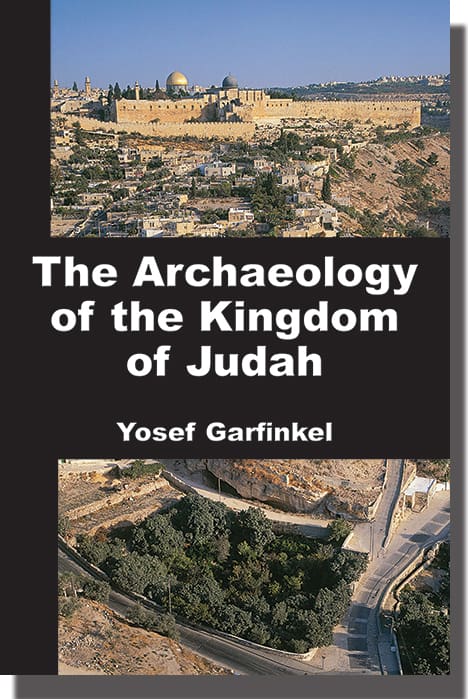
The Archaeology of the Kingdom of Judah
By Yosef Garfinkel
(Atlanta: SBL Press, 2025), 453 pp. / $80 (paperback or eBook)
Reviewed by Thomas E. Levy
In The Archaeology of the Kingdom of Judah, Yosef Garfinkel has produced what is, remarkably, the first comprehensive synthesis devoted entirely to the archaeology of biblical Judah. That such a book could only be written now is itself significant. Over the past 15 to 20 years, a wave of new discoveries—from the City of David in Jerusalem to sites across the Shephelah and Negev and in neighboring Edom—has transformed the evidentiary landscape. What was once a fragmentary and contested field has matured into one that can finally sustain a synthetic treatment. Garfinkel’s volume is the first to fully capitalize on this new archaeological reality.
At the heart of the book is a clear and ambitious goal: to reconstruct the development of the kingdom of Judah from its earliest phases through its destruction by Babylon in 586 BCE. Garfinkel does so by organizing the archaeological data into a five-part chronological framework, beginning with the period traditionally associated with David and Solomon. Crucially, this framework is not based solely on ceramic typology or historical inference, but draws heavily on recent advances in radiometric dating, now applied across multiple key sites—including Jerusalem itself. The result is a more refined and empirically grounded chronology than has previously been possible.
This chronological structure allows Garfinkel to revisit one of the most debated questions in biblical archaeology: the nature of Judah in the tenth century BCE. Against minimalist reconstructions that portray Judah as a marginal or non-state entity at this time, Garfinkel argues for the existence of a small but organized kingdom, anchored in fortified sites such as Khirbet Qeiyafa and extending into the hill country and Shephelah. Whether or not one accepts all aspects of this reconstruction, the argument is presented clearly and supported by a growing body of archaeological data.
One of the book’s major strengths is its ability to link archaeological horizons with historically attested events. Garfinkel correlates destruction layers and settlement patterns with episodes known from the Hebrew Bible and ancient Near Eastern sources, including Assyrian campaigns and the Babylonian conquest. These correlations are handled with care, avoiding simplistic one-to-one identifications while still demonstrating the potential for meaningful historical integration.
Equally important is Garfinkel’s methodological clarity. He explicitly addresses the long-standing tension between archaeology and the biblical text, laying out a three-stage approach: first analyzing the archaeological data independently, then considering external written sources, and only finally turning to the biblical narrative. At the same time, he does not ignore competing interpretations. Throughout the book, alternative views—particularly those associated with minimalist or low-chronology approaches—are presented and discussed. This willingness to engage with opposing perspectives strengthens the volume and makes it a valuable resource for both specialists and informed readers.
The book is also visually impressive. With more than 175 high-quality illustrations—maps, plans, photographs, and artifact images in both color and black and white—it succeeds in making complex archaeological data accessible without sacrificing detail. For readers of Biblical Archaeology Review, this is an especially welcome feature, as it allows the material culture of Judah to be seen as well as described.

Of course, the subject matter remains inherently contentious. Some scholars will question whether the evidence from a limited number of key sites can sustain broader claims about early state formation in Judah. Others may challenge specific identifications or chronological conclusions. Yet Garfinkel is fully aware of these debates and addresses them directly. The book does not attempt to close the discussion but rather to advance it—substantially.
In this respect, The Archaeology of the Kingdom of Judah is best understood as both a synthesis and a statement. It brings together a vast body of new data while also articulating a coherent interpretive framework. Even readers who disagree with aspects of Garfinkel’s conclusions will find the presentation of the evidence clear, comprehensive, and thought-provoking.
In sum, this is a masterfully executed work that marks a turning point in the study of Judah’s archaeology. By integrating recent discoveries, advances in scientific dating, and a careful engagement with textual traditions, Garfinkel has provided a foundation for future research—and a compelling new perspective on the biblical world.
Thomas E. Levy is Distinguished Professor and inaugural holder of the Norma Kershaw Chair in the Archaeology of Ancient Israel and Neighboring Lands at the University of California, San Diego. He specializes in ancient technology and social evolution.
Become a BAS All-Access Member Now!
Read Biblical Archaeology Review online, explore 50 years of BAR, watch videos, attend talks, and more

The post Reconstructing Judah appeared first on Biblical Archaeology Society.
Comments
Post a Comment