
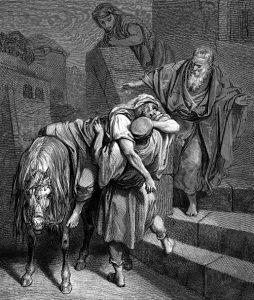
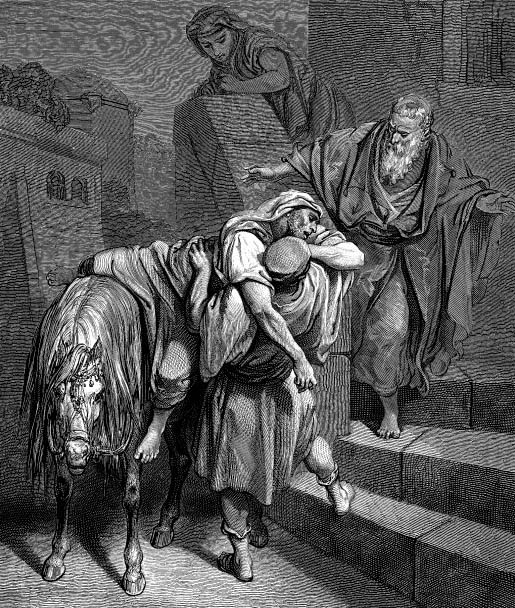
Gustave Dore, The Good Samaritan. Dr. Amy-Jill Levine of Vanderbilt University explains how getting an accurate answer to the question “Who were the Samaritans?” can shed light on how shocking the Good Samaritan parable would have been to Jesus’ audience.
The Good Samaritan parable is one of the most beloved gospel stories for young and old alike. The story is told in Luke 10:29–37: A man going from Jerusalem to Jericho is attacked by robbers who strip him and beat him. A priest and a Levite pass by without helping him. But a Samaritan stops and cares for him, taking him to an inn where the Samaritan pays for his care.
As Dr. Amy-Jill Levine discusses in a column in the January/February 2012 issue of Biblical Archaeology Review, the story has proven a popular one for sermons over the years, and it has been interpreted in many different ways—ranging from a tale about ritual purity to lessons about personal safety and even freedom fighters or universal healthcare. These sometimes-unusual interpretations are no doubt an attempt to find meaning in the parable for the times and concerns of a changing audience. And although that may be a worthy cause, Levine notes that in order to grasp the full import of the story, one must understand the times and concerns of first-century Judea, where Jesus and his followers lived. To do this, one must understand the relationship between Jews and Samaritans. This is sometimes hinted at in modern interpretations of the parable but rarely fully grasped.

FREE ebook: The Galilee Jesus Knew
So who were the Samaritans, really? Levine explains that they were not simply outcasts: They were the despised enemies of the Jews. Yet where listeners would have expected a Jew to be the hero of Jesus’ story, instead they would have been shocked to hear that it is a Samaritan. As Levine explains, only by understanding this reality does the powerful message of the parable come through:
The parable offers … a vision of life rather than death. It evokes 2 Chronicles 28, which recounts how the prophet Oded convinced the Samaritans to aid their Judean captives. It insists that enemies can prove to be neighbors, that compassion has no boundaries, and that judging people on the basis of their religion or ethnicity will leave us dying in a ditch.
Read more from Dr. Amy-Jill Levine about interpreting the Good Samaritan parable in Biblical Views, “The Many Faces of the Good Samaritan—Most Wrong,” Biblical Archaeology Review, January/February 2012.
Not a BAS Library or All-Access Member yet? Join today.
This article was originally published in Bible History Daily January 2012.
Related reading in Bible History Daily
All-Access members, read more in the BAS Library
Biblical Views: The Many Faces of the Good Samaritan—Most Wrong
Not a BAS Library or All-Access Member yet? Join today.
The post Understanding the Good Samaritan Parable appeared first on Biblical Archaeology Society.
Comments
Post a Comment