
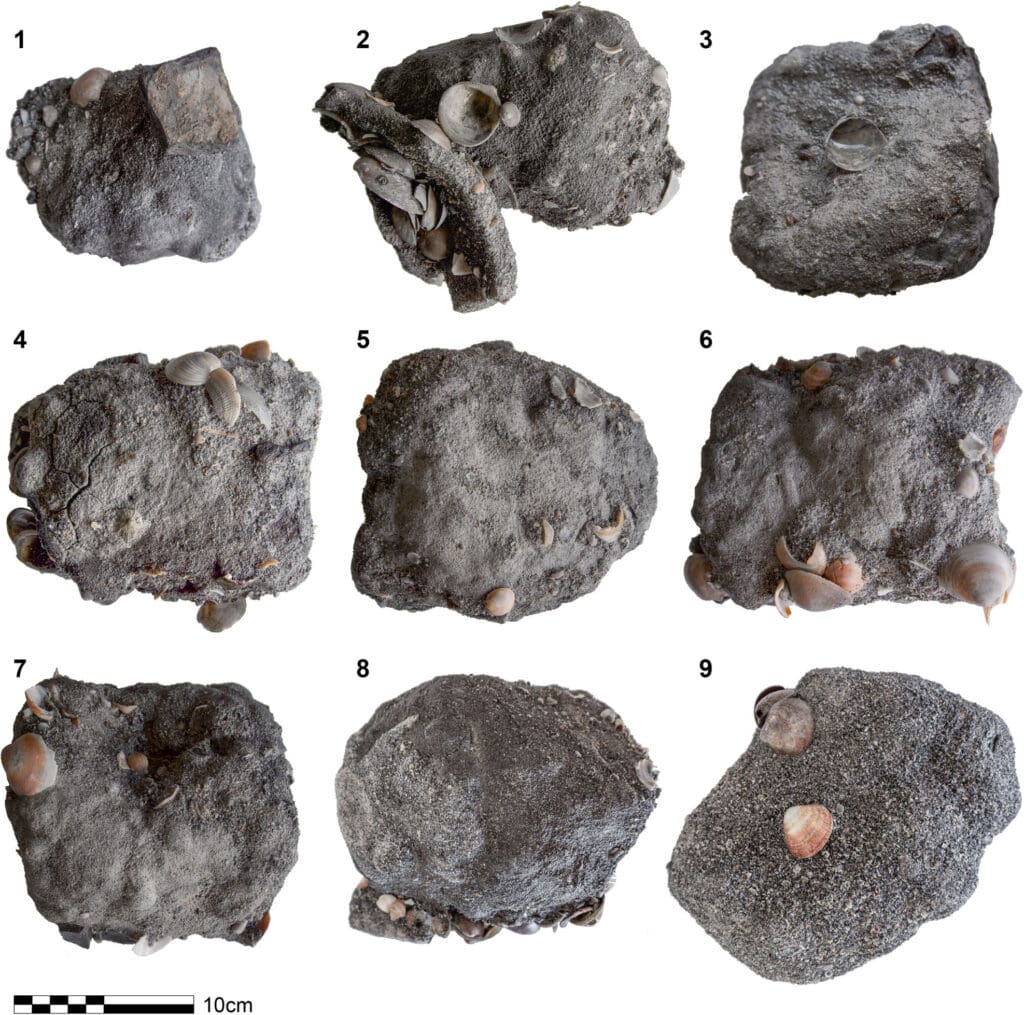
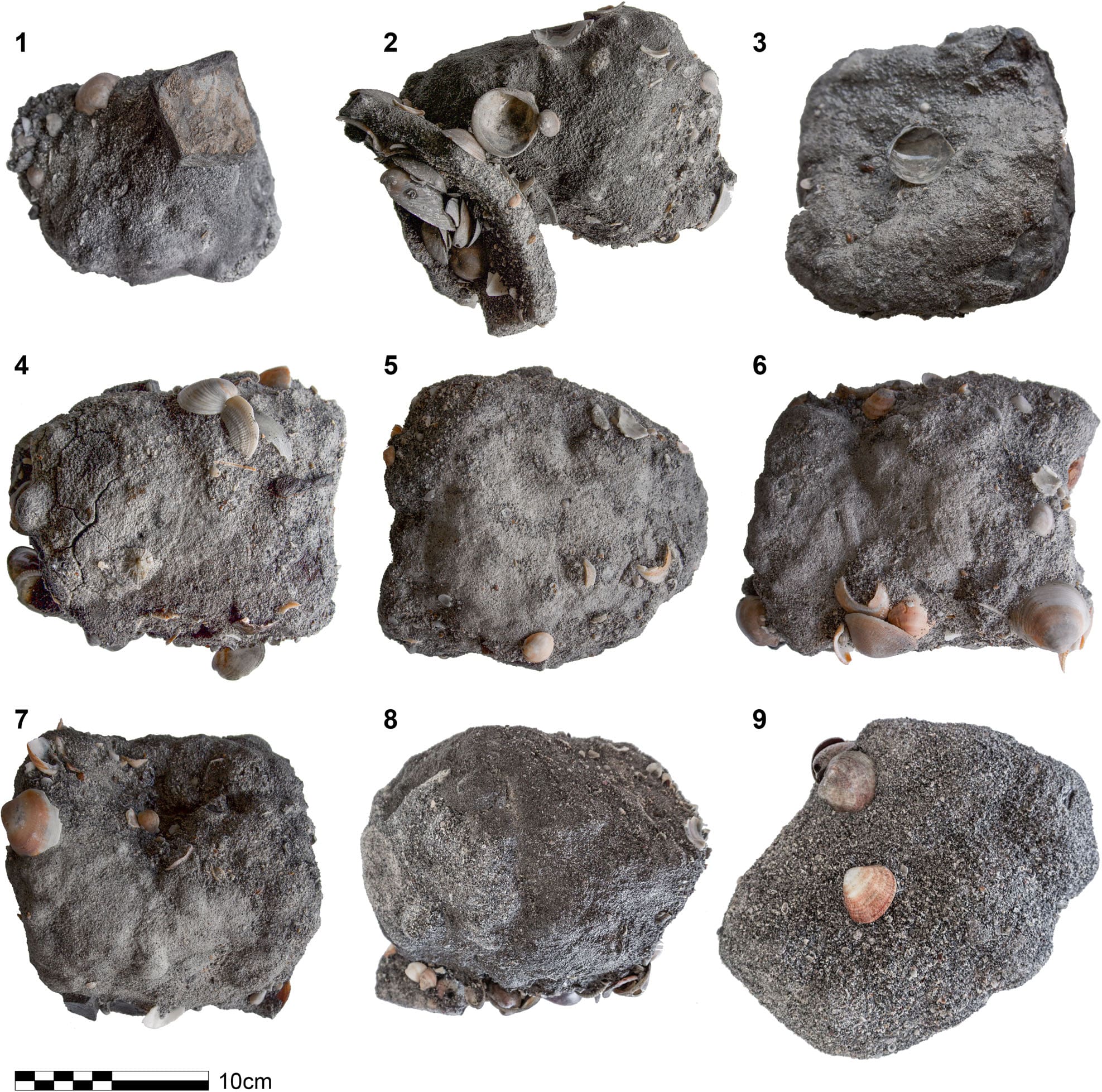
Iron blooms found in the Dor Lagoon, south of Haifa along the Carmel Coast in Israel. Courtesy Tzilla Eshel et al., “Earliest Iron Blooms Discovered off the Carmel Coast Revise Mediterranean Trade in Raw Metal ca. 600 BCE,” npj Heritage Science 14 (2026), CC-BY-NC-ND 4.0. Photo by Marko Runjajić.
In the ancient world, producing iron was an intricate, labor-intensive process. Iron ore was removed from the earth and then heated with charcoal in a furnace, stopping just short of melting the metal completely. This process, called smelting, caused the iron to separate from impurities, forming a porous, spongy mass called a bloom. Smiths would then hammer the bloom repeatedly to remove the impurities (the “slag”), leaving bars of iron that could be forged into tools, weapons, and other objects.
Historians have assumed that blooms were worked immediately after smelting in antiquity, but a new study off the Carmel coast reveals something surprising: some blooms were left intact, intended not for immediate forging but for transport and trade. This changes how scholars understand the movement of iron through early Mediterranean economies in the age that takes its name from this metal: the Iron Age.
The Iron Age (c. 1200–586 BCE), which followed the Bronze Age and the Stone Age, serves as the historical backdrop for much of the Hebrew Bible, including the rise of early Israelite society and neighboring kingdoms. These periods are named for the dominant materials used for weapons and tools, reflecting how advances in technology reshaped human life. In the Stone Age, implements were made from stone; in the Bronze Age, humans learned to alloy copper with tin to produce stronger, more versatile tools; and in the Iron Age, iron became the defining material, driving major technological, economic, and social transformations.
Iron was stronger, more abundant, and more accessible than bronze, allowing smelting to spread beyond elite centers. Yet it did not come into widespread use until later because it was more difficult to extract and work. Smelting iron requires higher, more controlled temperatures than those needed for bronze, and the process produces blooms as opposed to fully molten metal. Once these techniques were mastered, however, iron rapidly overtook bronze as the dominant material, revolutionizing agriculture with more efficient plows and axes, transforming warfare through the mass production of weapons, and enabling expanded settlement through improved abilities in construction.

The team behind this discovery was excavating in the Dor Lagoon, a shallow coastal site near the ancient harbor of Tel Dor, when they uncovered nine iron blooms, each weighing between 11 and 22 pounds. Unlike most iron artifacts from the ancient world, these blooms were unworked and still encased in slag. The scholars found no signs of hammering, indicating that these blooms had never undergone the expected processes of ironworking aside from being smelted.
Fortuitously, one of the Dor blooms had a charred oak twig embedded in its slag. This enabled researchers to perform radiocarbon dating—a method only possible when carbon is present, such as in organic matter—and determine that the plant was last alive in the late seventh to early sixth centuries BCE. This provides an estimate for when the bloom was smelted. Remarkably, the slag adhering to the bloom’s surfaces acted as a protective shell, shielding the iron from corrosion during centuries underwater. These findings make this cargo the earliest securely dated industrial iron products yet identified in the Mediterranean.
The Dor blooms demonstrate that iron blooms were transported as a tradable commodity. The recent study suggests iron moved along maritime routes well before being crafted into finished goods. Moreover, the Dor cargo was found with Cypriot and Aegean‑style amphorae, hinting at broader Mediterranean trade connections between the Levant, Cyprus, and the Aegean.
Lauren K. McCormick is an assistant editor at Biblical Archaeology Review and a specialist in ancient Near Eastern religions, visual culture, and the Bible. She holds degrees in religion from Syracuse University, Duke University, New York University, and Rutgers University, and completed a postdoctoral fellowship on religion and the public conversation at Princeton University.
Become a BAS All-Access Member Now!
Read Biblical Archaeology Review online, explore 50 years of BAR, watch videos, attend talks, and more

Related reading in Bible History Daily
All-Access members, read more in the BAS Library
How Iron Technology Changed the Ancient World and Gave the Philistines a Military Edge
Not a BAS Library or All-Access Member yet? Join today.
The post Understanding Iron in the Iron Age appeared first on Biblical Archaeology Society.
Comments
Post a Comment