
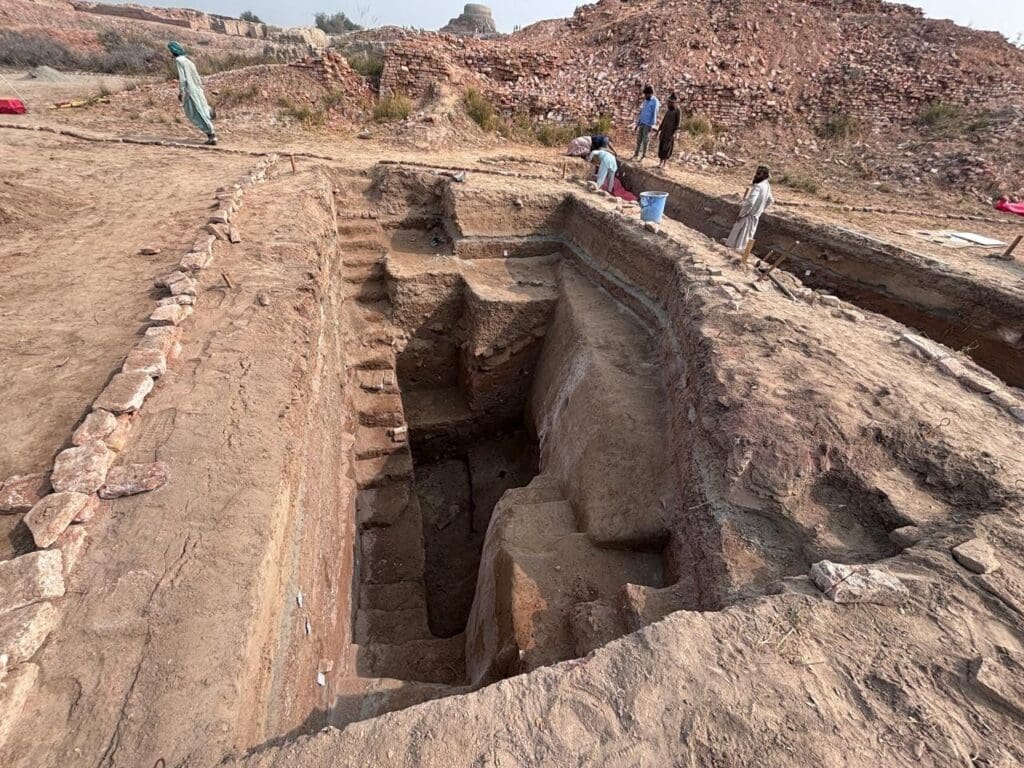
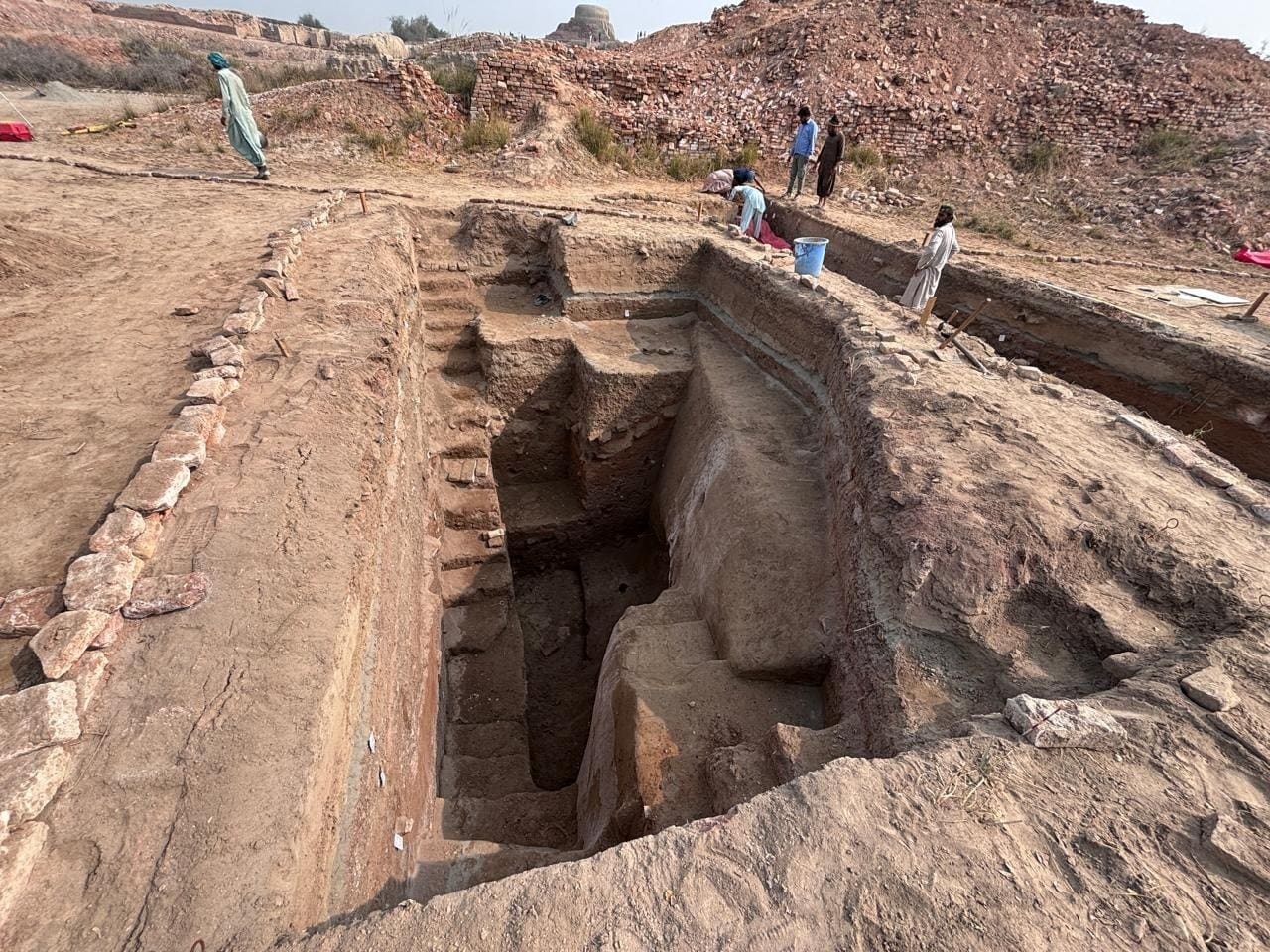
Recent excavation at Mohenjo-Daro in modern day Pakistan, the two later two phases of the wall visible on the right. Courtesy the Directorate General of Antiquities and Archaeology of the Sindh Government.
The ancient city of Mohenjo-Daro, one of the major cities of the Indus Valley civilization, is the focus of new scientific investigations. The Directorate General of Antiquities and Archaeology of the Sindh Government reported on social media that a large mudbrick wall at the site—measuring approximately 23 feet high and 20 feet wide—has been sampled for geoarchaeological analysis. While the structure itself is significant, its deeper importance lies in what these samples may reveal about the timing, construction, and environmental history of the site and the broader role the Indus Valley played in the development of early civilization.
The Indus Valley civilization was a major Bronze Age society spanning parts of modern-day Pakistan, northwest India, and eastern Afghanistan. It is known for highly organized urban planning, standardized baked-brick architecture, advanced sanitation systems, public granaries, and extensive long-distance trade networks, including with Mesopotamia. Its chronology, as explained to Bible History Daily by J. Mark Kenoyer from the Mohenjo-Daro archaeological team, is best described using a framework of the Regionalization Era (Early Harappan Phase, 4500–2600 BCE), the Integration Era (Harappan Phase, 2600–1900 BCE), and the Localization Era (Late Harappan Phase, 1900–1300 with some regions continuing to 1000 BCE).
The researchers collected mudbrick samples from multiple vertical levels of the wall in order to investigate its construction and later modifications. Laboratory analysis may help identify the sources of raw materials, determining whether clay and temper were locally obtained or transported from elsewhere. The research may also reveal brick-making techniques and the degree of their standardization. The results of these analyses are expected to be published once laboratory testing is complete (stay tuned!).
Compositional data may also provide evidence for environmental conditions during the times of the wall’s (re)construction, since mudbricks can preserve indirect chemical, mineral, and sedimentary markers reflecting the surrounding landscape from which they were formed. These markers can show long-term climatic trends affecting soils, rivers, and settlement conditions. Shifts in the strength of annual monsoons, for example, would influence river behavior, water availability, and floodplain dynamics. This data will be very significant, since climate change is one of several proposed explanations for the decline of the Indus Valley civilization during the second millennium BCE.
The stakes of this research are unusually high: They impact how we understand the emergence of early urban life. The Indus Valley civilization is often placed alongside ancient Egypt and Mesopotamia as one of the world’s first great centers of civilization. However, the Indus region only began being excavated in the early 1920s—roughly 70 to 100 years after major breakthroughs in Egyptian and Mesopotamian archaeology. Small shifts in chronology—whether a structure dates slightly earlier or later—can reshape broader narratives about when cities formed, how quickly they developed, and whether different regions influenced one another or evolved independently.
For readers of the Bible, Abraham is often placed in the early second millennium BCE, within a Mesopotamian context (Genesis 11:31). The Indus civilization—represented by sites like Mohenjo-Daro—is already known to have roots extending well before this period, reinforcing the idea that Abraham lived in a world already populated by multiple highly developed urban centers. While there is no direct connection between the biblical narrative and the Indus Valley (but see evidence of trade), refining the chronology of one region inevitably reshapes the broader historical backdrop of the other, underscoring that the story of early civilization was never confined to a single place or people.
Lauren K. McCormick is an assistant editor at Biblical Archaeology Review and a specialist in ancient Near Eastern religions, visual culture, and the Bible. She holds degrees in religion from Syracuse University, Duke University, New York University, and Rutgers University, and completed a postdoctoral fellowship on religion and the public conversation at Princeton University.
Become a BAS All-Access Member Now!
Read Biblical Archaeology Review online, explore 50 years of BAR, watch videos, attend talks, and more

Related reading in Bible History Daily
All-Access members, read more in the BAS Library
Not a BAS Library or All-Access Member yet? Join today.
The post What an Indus Valley Civilization Wall May Reveal about Early Cities appeared first on Biblical Archaeology Society.
Comments
Post a Comment