
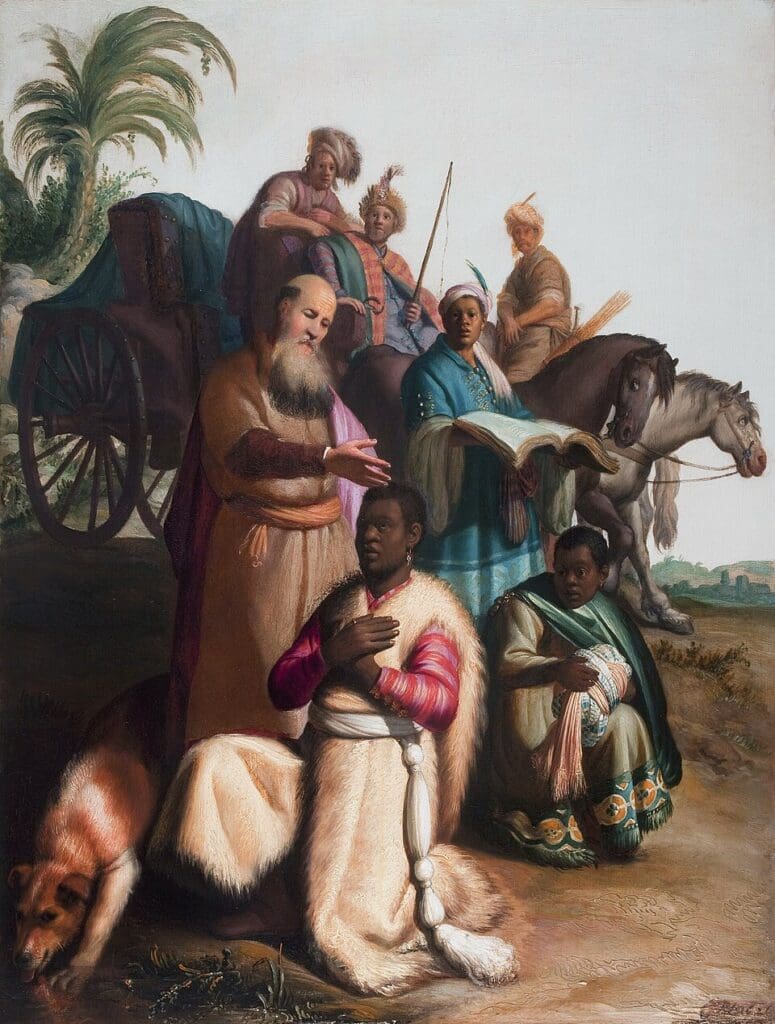
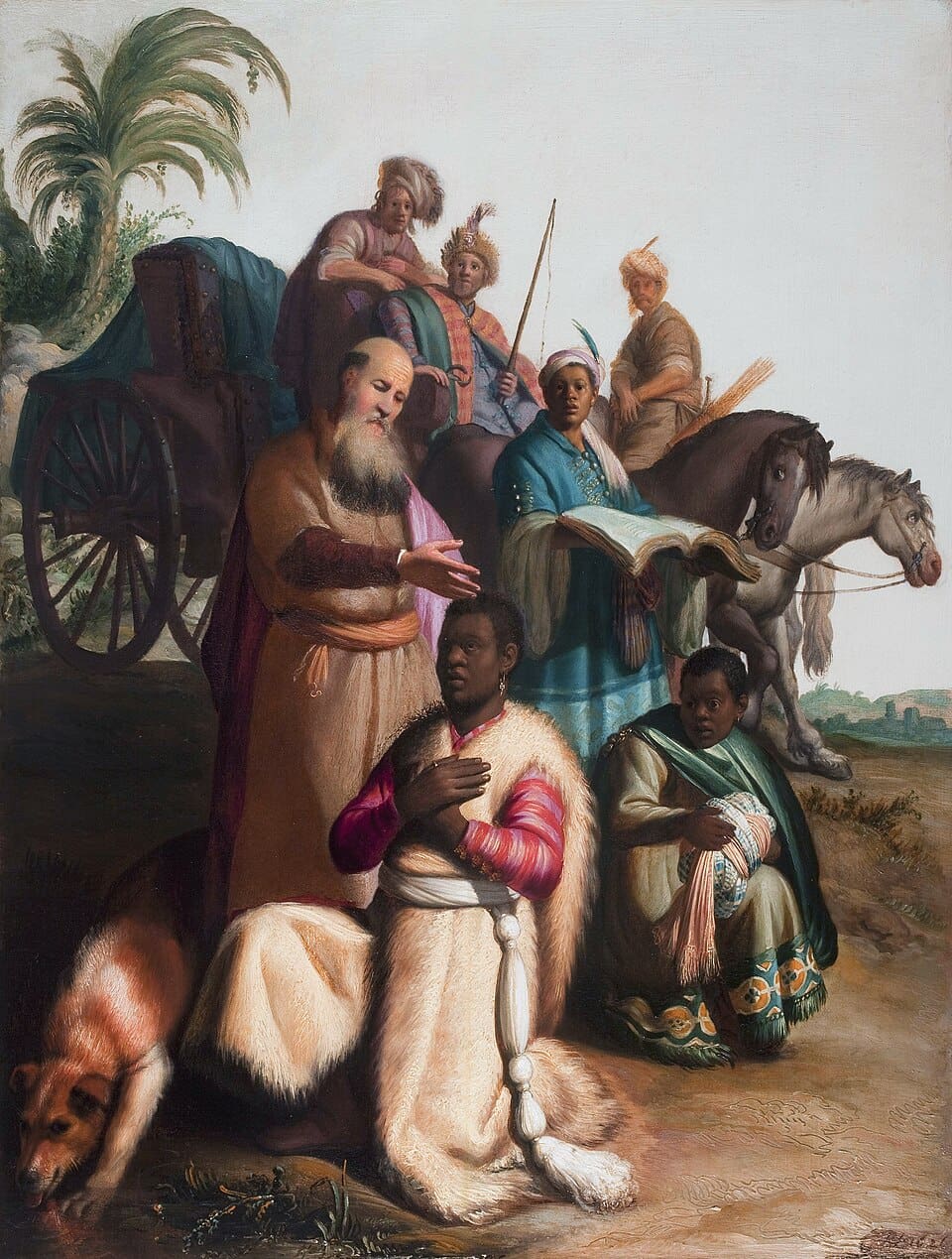
Rembrandt, The Baptism of the Eunuch (1626). Public domain via Wikimedia Commons.
It is common in the Acts of the Apostles to present brief episodes of evangelization that move rapidly across space, with little sustained interest in the personal histories of those who convert. One example occurs in Acts 8, where an Ethiopian eunuch is baptized by Philip the Evangelist, one of the first seven deacons.
The eunuch is described as an “Ethiopian,” and as an official in charge of the treasury of the candace (the Nubian queen), traveling home from Jerusalem where he had gone to worship. The Ethiopian eunuch is reading a suffering servant passage from the book of Isaiah on his journey, when Philip is divinely directed to join him. After hearing Philip’s interpretation of the text, the Ethiopian eunuch requests to be baptized at a roadside body of water, which Philip accommodates. Afterward, Philip is abruptly taken away by the Spirit and the Ethiopian eunuch rejoicingly departs—never to be mentioned again.
The combination of prominence in the moment and complete silence afterward makes the Ethiopian eunuch a classic minor character in Acts. His presentation is comparable to figures such as Stephen (Acts 6–7) and Cornelius the Centurion (Acts 10–11), and to be contrasted with figures like Philip the Evangelist, Saul/Paul, and Peter, who anchor longer narrative arcs across the book. The Ethiopian eunuch receives a vivid narrative portrait only to drop out of the story after his baptism.

In the Spring 2026 issue of Biblical Archaeology Review, scholar Mark Wilson offers one entry point into this complex issue by reexamining the term “eunuch.” Wilson argues with William H. Willimon that the term may clarify an important aspect of this figure’s identity. While the Greek term eunouchos is lexically ambiguous—capable of meaning either a physically castrated man or a high-ranking court official—Wilson argues that in Acts 8 it is most likely an administrative designation. As a parallel, the Greek translation of the Hebrew description of Potiphar also uses eunouchos (Genesis 39:1), without any affiliation with castration—indeed, an uncommon practice in Egypt.
This interpretive shift has religious ramifications. Deuteronomy 23:1 restricts Temple worship for eunuchs, leading some to consider the Ethiopian eunuch a gentile and perhaps the first one to convert to Christianity (preceding Cornelius the Centurion from Acts 10:1–11:18). However, Acts is clear that the Ethiopian eunuch traveled to Jerusalem for the purposes of worship. If “eunuch” refers to his status as an official, and not to his bodily state, the potential restrictions on Jewish worship disappear. Indeed, the Ethiopian eunuch’s actions—traveling to worship in Jerusalem and reading Isaiah—align more naturally with that of a religious insider.
As it happens, Jews did live in Egyptian settlements along the Nile throughout the Ptolemaic and early imperial periods. In the context of Acts, the term “Ethiopian” does not refer to the modern country of Ethiopia, but more broadly to the region south of Egypt, often identified with Nubia (ancient Cush). Nubian forces invaded southern Egypt around 22 BCE, and Wilson suggests that Jewish prisoners may have been brought to Nubia at that time, later forming settlements. On this reading, the Ethiopian eunuch’s geographic designation does not place him outside the Jewish world so much as on its southern periphery, increasing the plausibility of a Jewish identity.
Wilson’s linguistic argument, then, reshapes the Ethiopian eunuch’s identity profile and the thrust of its relevance for Christianity’s development. With the eunuch understood as a court official rather than a castrated religious outsider, the story depicts the Christian message entering elite, transregional imperial networks through the Ethiopian eunuch.
Textually, the Ethiopian eunuch’s episode turns on the interpretation of a passage from Isaiah 53, part of the “suffering servant” tradition. For early Christians, this figure functions as a key hinge between Israel’s scriptures and their perceived fulfillment in Jesus. The Hebrew term māšîaḥ and its Greek equivalent christos, meaning “anointed one,” do not originally refer to a single, unified figure but to a range of expected roles in Israel’s tradition, including Davidic royal kings (2 Samuel 7), an apocalyptic end-time ruler (Daniel 7), and, as here, a suffering servant who is rejected and later vindicated (Isaiah 52–53). In the scene, Philip applies a major messianic expectation to Jesus, driving the Ethiopian eunuch’s conversion.
The narrative in Acts is organized around the expansion of Christianity from Jerusalem to Judea and Samaria, and ultimately to the “ends of the earth.” The Ethiopian eunuch is geographically distant, socially elevated (a treasury official), and, if Wilson is correct, a Jew open to seeing Jesus as the fulfillment of scripture. In this sense, the Ethiopian eunuch functions as one node within the larger narrative structure of Acts, which is less concerned with individual life stories than with the unstoppable crossing of boundaries that defines its vision of the early Christian movement.
For more, read “Philip’s Encounter with the ‘Ethiopian Eunuch’” by Mark Wilson, in the Spring 2026 issue of Biblical Archaeology Review.
Subscribers: Read the full article, “Philip’s Encounter with the ‘Ethiopian Eunuch’” by Mark Wilson, in the Spring 2026 issue of Biblical Archaeology Review.
Lauren K. McCormick is an assistant editor at Biblical Archaeology Review and a specialist in ancient Near Eastern religions, visual culture, and the Bible. She holds degrees in religion from Syracuse University, Duke University, New York University, and Rutgers University, and completed a postdoctoral fellowship on religion and the public conversation at Princeton University.
Become a BAS All-Access Member Now!
Read Biblical Archaeology Review online, explore 50 years of BAR, watch videos, attend talks, and more

Related reading in Bible History Daily
All-Access members, read more in the BAS Library
Not a BAS Library or All-Access Member yet? Join today.
The post Who Was the Ethiopian Eunuch? appeared first on Biblical Archaeology Society.
Comments
Post a Comment